
Trier sits where the Moselle bends through a wide valley, just 15 kilometers from the Luxembourg border. Founded by Augustus in 16 BCE, it served as the capital of the Western Roman Empire for nearly two centuries and holds more standing Roman monuments north of the Alps than anywhere else.
We’ve walked through enough medieval German towns to know when something older is underneath. In Trier, that older layer isn’t buried—it’s the main attraction.
The Porta Nigra and the Roman Core
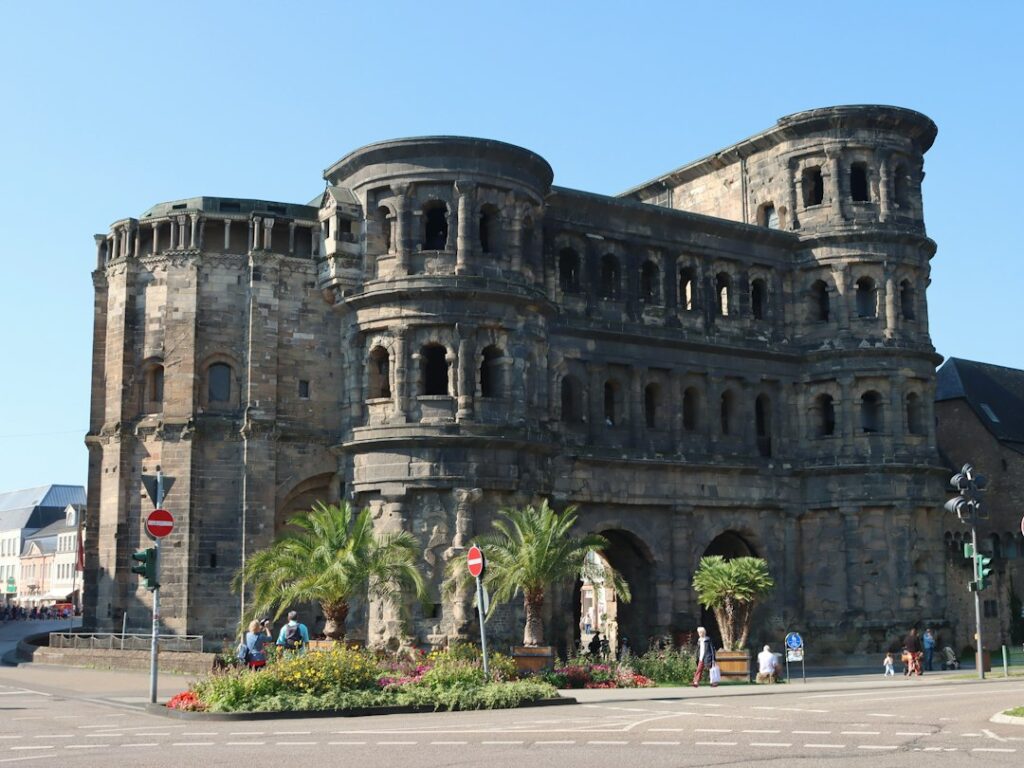
The Porta Nigra stands at the north edge of the old town, a massive sandstone gate built around 170 CE without mortar—iron clamps held the blocks together. It’s the best-preserved Roman city gate anywhere, its blackened stone giving it the name “Black Gate.” You can climb through the interior passages and stand on the upper levels where Roman soldiers once watched the road from Gaul.
From the gate, Simeonstraße runs south through the pedestrian center, following the line of the old Roman cardo. The street opens onto the Hauptmarkt, where a market has operated continuously since the Middle Ages. The Marktkreuz fountain dates to 958, and the square is ringed by Renaissance and Baroque facades, but dig down and you’ll find Roman cellars beneath nearly every building.
The Constantine Basilica is a short walk east—a bare brick hall 67 meters long that once served as the throne room of Emperor Constantine. It’s the largest surviving single-room structure from antiquity, and the scale is startling. The Protestant church that uses it now has left the interior open, so you can see the full Roman proportions. Stand at the far end and imagine the emperor receiving envoys beneath a gilded apse.
Imperial Baths and Amphitheater
The Imperial Baths lie just south of the basilica, begun under Constantine but never completed. You can walk through the underground service corridors where slaves stoked the furnaces and carried water, then climb up to what would have been the hot bath halls. The ruins are extensive enough to understand the layout: caldarium, tepidarium, frigidarium, and palaestra.
The Roman Amphitheater sits on the eastern slope above the old town, carved partly into the hillside. Built around 100 CE, it held 20,000 spectators—more than the current population of Trier’s old town. You can walk down into the cellars beneath the arena floor where gladiators and animals waited. The structure is smaller than the Colosseum but better preserved than most provincial amphitheaters, and the view from the upper tiers across the Moselle valley is worth the climb.
Cathedral, Wine, and the Moselle Shore
The Trierer Dom is the oldest cathedral in Germany, built on the foundations of Constantine’s palace church. Roman brick walls still stand in the core, visible inside the transept. The cathedral treasury holds the Holy Robe, a tunic venerated as Christ’s seamless garment—it’s only displayed in pilgrimage years, but the treasury’s Roman and medieval artifacts are open year-round.
Trier sits in the heart of Moselle wine country. The vineyards start just outside the city limits, climbing the slate slopes that give Riesling its mineral edge. Bischöfliches Weingut operates a tasting room near the cathedral, pouring wines from parcels the bishops have owned since the 10th century. For a longer tasting, cross the river to Weingut von Othegraven in Kanzem, a 15-minute drive north.
The Moselle promenade runs along the west bank, lined with plane trees and riverside cafés. In summer, locals swim off the grassy banks near the Römerbrücke, a bridge built in the 2nd century CE that still carries traffic on its Roman piers.
Visiting Trier
Trier is 50 minutes by train from Koblenz and two hours from Luxembourg. The Antiquities Card covers admission to all Roman sites and is available at the Porta Nigra. Most travelers visit between April and October, when the outdoor monuments are easiest to explore. November through March is quieter, and the Roman cellars and the Dom are open year-round.
If you visit in December, the Christmas market fills the Hauptmarkt and spills into the cathedral square, with stalls backed by floodlit Roman stone. Spring and fall bring fewer crowds and better light for photography, especially in the late afternoon when the sun hits the sandstone of the Porta Nigra.
Trier is small enough to walk in a day, but the density of monuments rewards a slower pace. Stay overnight and you’ll have the amphitheater and the basilica almost to yourself before the tour buses arrive.
We send one short story about Germany to your inbox every day—subscribe to the Love Germany newsletter and we’ll bring you inside the country’s towns, landscapes, and tables, one detail at a time.
Tours & experiences in Germany


Powered by Viator. Some links are affiliate links — we may earn a small commission at no extra cost to you.