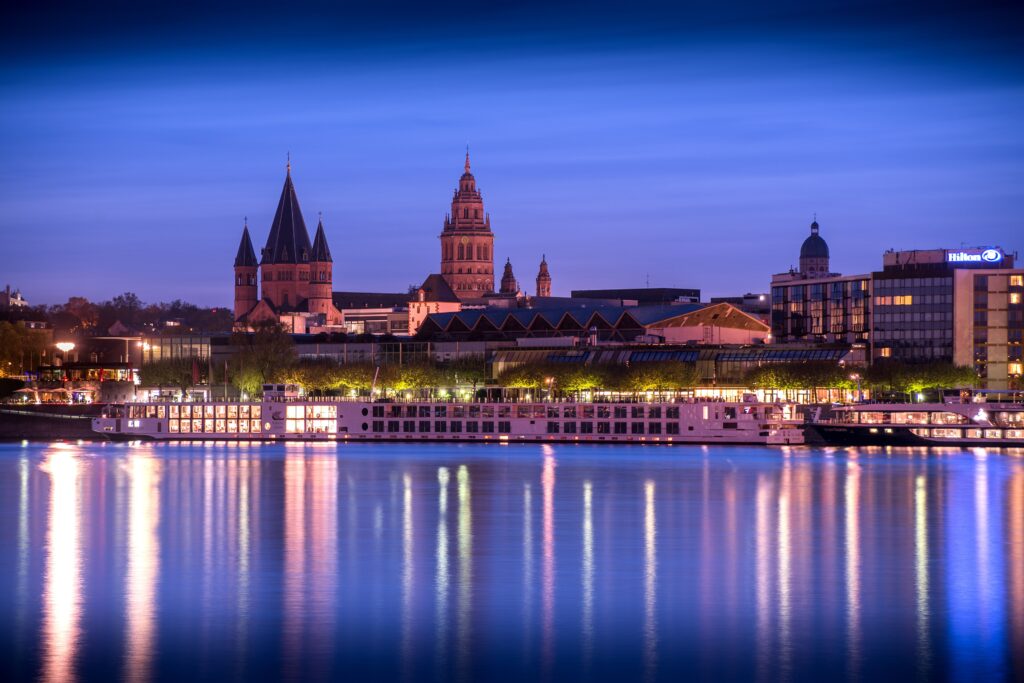
Mainz sits at the confluence of the Rhine and Main rivers, a location that made it a Roman stronghold, a prince-bishop’s seat, and the birthplace of movable type. Today the capital of Rhineland-Palatinate delivers Roman stonework, a Romanesque cathedral, Johannes Gutenberg’s original press, and a carnival that rivals Cologne’s for scale and audacity.
The city’s compact center sits on the west bank of the Rhine, directly across from Wiesbaden. You can walk from the train station to the cathedral in ten minutes, and most of the major sites cluster within a few blocks of each other.
The Gutenberg Museum and the Birth of Print
The Gutenberg Museum occupies a Renaissance building steps from the cathedral. Inside, two original Gutenberg Bibles rest in a climate-controlled vault—one printed on vellum, one on paper. The museum recreates Gutenberg’s workshop in the basement, where guides demonstrate how individual lead letters were cast, composed, inked, and pressed onto rag paper. The scent of linseed oil and metal fills the room.
Gutenberg developed his movable-type system in Mainz in the 1450s, a technical leap that required innovations in metallurgy, ink chemistry, and press engineering. The museum traces printing from Chinese woodblocks through digital typography, but the highlight remains those two Bibles and the working replica press.
Roman Mainz and the Landesmuseum
The Landesmuseum Mainz houses one of Germany’s finest collections of Roman stonework. Mainz was Mogontiacum, a legionary fortress that anchored the Rhine frontier for four centuries. The museum’s ground floor displays altars, stelae, and funerary monuments carved by Roman soldiers and traders, many still bearing sharp inscriptions in Latin.
The Jupitersäule—a monumental column dedicated to Jupiter—stands reconstructed in the courtyard. The original fragments were unearthed near the cathedral in 1905, and the column would have risen more than nine meters high when intact. Upstairs, the collection shifts to medieval sculpture, Renaissance painting, and Jugendstil glass.
For in-situ Roman remains, walk to the Römisches Theater on the southern edge of the old town. The semicircular stone tiers seated 10,000 spectators and are now partially excavated and open to the public. A small visitor center explains the layout and function of the complex.
Mainz Cathedral and the Old Town
The Mainzer Dom rises in red sandstone, a Romanesque pile with Gothic and Baroque additions spanning nine centuries. Six towers mark the skyline, and the interior preserves tombs of prince-archbishops who wielded both spiritual and temporal power over the Rhineland. The cloister hosts a diocesan museum with medieval vestments and reliquaries.
Around the cathedral, the Altstadt reveals its bones. Half-timbered houses lean over cobbled lanes on the Kirschgarten and Augustinerstraße. The market square hosts a produce and flower market six mornings a week, with vendors selling asparagus in spring and federweisser—young, fermenting wine—in autumn.
Carnival and the Fastnacht Spirit
Mainz shares the Rhineland’s deep investment in Fastnacht, the carnival season that peaks in the week before Ash Wednesday. The Mainzer Fastnacht kicks off on November 11 at 11:11 a.m., but the real action comes in late February or early March, when the Rosenmontagszug—Rose Monday parade—fills the streets with floats, brass bands, and costumed guilds throwing candy and flowers into the crowd.
The Fastnachtsmuseum operates year-round in a former arsenal, displaying costumes, medals, and papier-mâché heads from past parades. The exhibits trace the tradition’s roots to medieval mockery of authority and explain the role of the Büttenrede—satirical speeches delivered in local dialect from a wooden tub.
Wine Taverns and the Rheinhessen Hinterland
Mainz anchors the Rheinhessen wine region, Germany’s largest by area. The city’s wine taverns pour Silvaner, Riesling, and Müller-Thurgau from villages a few kilometers inland. Weingut Schales in Flörsheim-Dalsheim and Weingut Keller in Flörsheim-Dalsheim rank among the top estates, but you can taste their wines in Mainz taverns like Eisgrub-Bräu or Heiliggeist.
Mainz Hauptbahnhof connects to Frankfurt in 35 minutes and Cologne in under two hours. The city makes a natural base for exploring the Rheingau across the river or the rolling vineyards of Rheinhessen to the west.
We send one short story about Germany every day to subscribers of the Love Germany newsletter. It’s the easiest way to keep the country close, even from afar.
Tours & experiences in Germany


Powered by Viator. Some links are affiliate links — we may earn a small commission at no extra cost to you.