
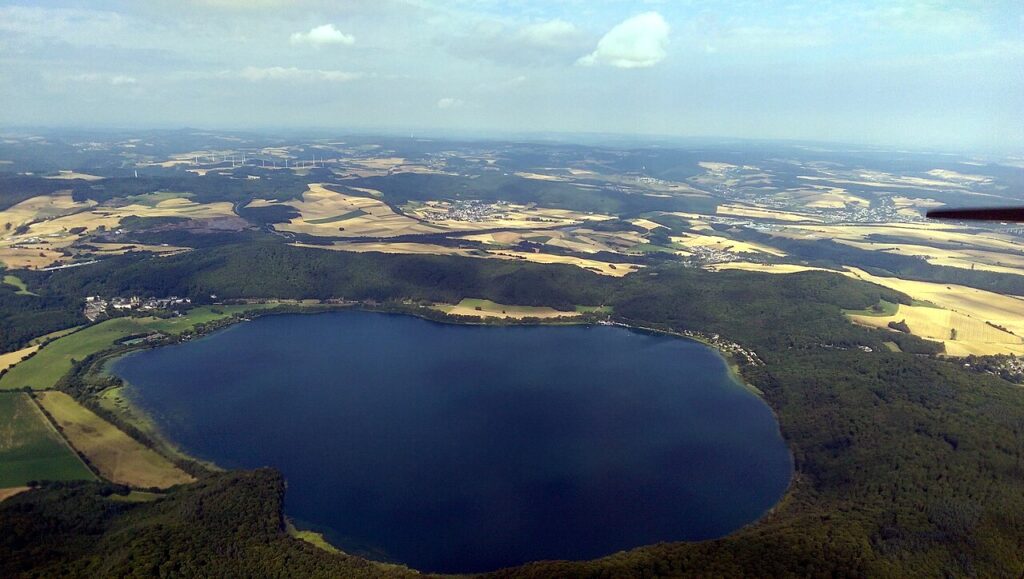
The Eifel doesn’t look like volcano country at first glance. Rolling hills, dense beech forests, sleepy villages with half-timbered houses—it reads more pastoral than geologic. But beneath those green slopes lies one of Central Europe’s youngest volcanic fields, and its most dramatic souvenirs are the Maare: nearly circular lakes filling ancient explosion craters.
There are more than seventy volcanic lakes in the region, though only a dozen true Maare—formed when rising magma met groundwater and exploded, leaving behind deep, steep-sided calderas. Today they’re among Germany’s most peaceful natural spots, ringed by hiking trails, rimmed with wildflowers, and almost impossibly blue.
The Three Crown Jewels: Daun’s Maare
The town of Daun sits at the heart of Maare country, and three lakes within a few kilometers form the classic introduction. The Gemündener Maar is the largest and most developed, with a swimming beach, boat rentals, and a lakeside café. It’s popular with families in summer but never crowded by Mediterranean standards.
A ten-minute drive north brings you to the Weinfelder Maar, also called the Totenmaar because a chapel on its shore once served funeral processions. There’s no swimming here—the lake is a nature reserve—but the 2.6-kilometer footpath around its rim is one of the loveliest short walks in the Eifel. Beech trees lean over the water, and in early morning the surface mirrors the sky so perfectly you lose track of the horizon.
The Schalkenmehrener Maar completes the trio. It’s the quietest of the three, with a grassy shoreline and a single Gasthaus where you can sit under chestnut trees and order trout caught from the lake that morning.
Pulvermaar: Germany’s Deepest Crater Lake
About fifteen kilometers southeast of Daun, near the village of Gillenfeld, the Pulvermaar plunges seventy-four meters deep—the deepest Maar in Germany and one of the deepest lakes in the country. The name means “powder lake,” a reference to the volcanic ash that once blanketed the area after the eruption roughly 25,000 years ago.
The water here is strikingly clear, fed entirely by springs rather than surface runoff. You can swim from a small pebble beach on the eastern shore, and the steep wooded slopes give the lake an almost alpine feel. A four-kilometer trail circles the Maar, rising and falling through oak and birch forest. In autumn, when the leaves turn, it’s spectacular.
Hiking the Maare-Mosel Trail
If you want to string together several lakes in one hike, the Maare-Mosel-Radweg also functions as a long-distance footpath. The full route runs fifty-eight kilometers from Daun west to the Moselle River at Bernkastel-Kues, passing five Maare, medieval castle ruins, and the picturesque lava-stone villages of Manderscheid and Bettenfeld.
Most walkers tackle it in three days, overnighting in guesthouses along the route. But you can easily sample shorter sections. The stretch from Daun to Manderscheid (about thirteen kilometers) takes in the Gemündener and Weinfelder Maare and delivers you to one of the Eifel’s prettiest thermal spa towns, where you can soak tired legs in warm mineral water.
Practical Tips for Visiting
The Eifel is best explored by car. Daun is roughly ninety minutes from Cologne or Trier, and the Maare are scattered across a wide area with limited public transit. That said, the town of Daun itself is served by regional trains from Koblenz (with a change in Gerolstein), and from there you can rent bikes or take local buses in summer.
Spring and early autumn are ideal. May brings wildflowers and migrating birds; September offers warm water, fewer visitors, and the first blush of fall color. Midsummer can be busy at the swimming lakes, but even then it’s low-key compared to the Rhine or Bavaria.
Pack a swimsuit if you’re visiting between June and September—the water in the Gemündener Maar and Pulvermaar stays cool but swimmable, and there’s something surreal about floating in a volcanic crater. Bring a picnic, too. There are cafés near the larger lakes, but the smaller Maare are wonderfully remote.
If you’re drawn to geology, stop by the Maarmuseum in Manderscheid. It’s small but excellent, with clear explanations (in German and English) of how the Maare formed and what makes the Eifel volcanically active to this day. Yes, active—scientists monitor seismic activity and carbon dioxide seeps. The last eruption was only 13,000 years ago, a blink in geologic time.
For a longer stay, base yourself in Daun or the spa town of Manderscheid. Both have family-run hotels and guesthouses where the owners know every trail, every Maar, and where to find the best Eifel lamb and trout.
Ready to discover more hidden corners of Germany? Subscribe to the Love Germany newsletter—one short story a day, straight to your inbox, celebrating the places and traditions that make this country unforgettable.
Tours & experiences in Germany


Powered by Viator. Some links are affiliate links — we may earn a small commission at no extra cost to you.