
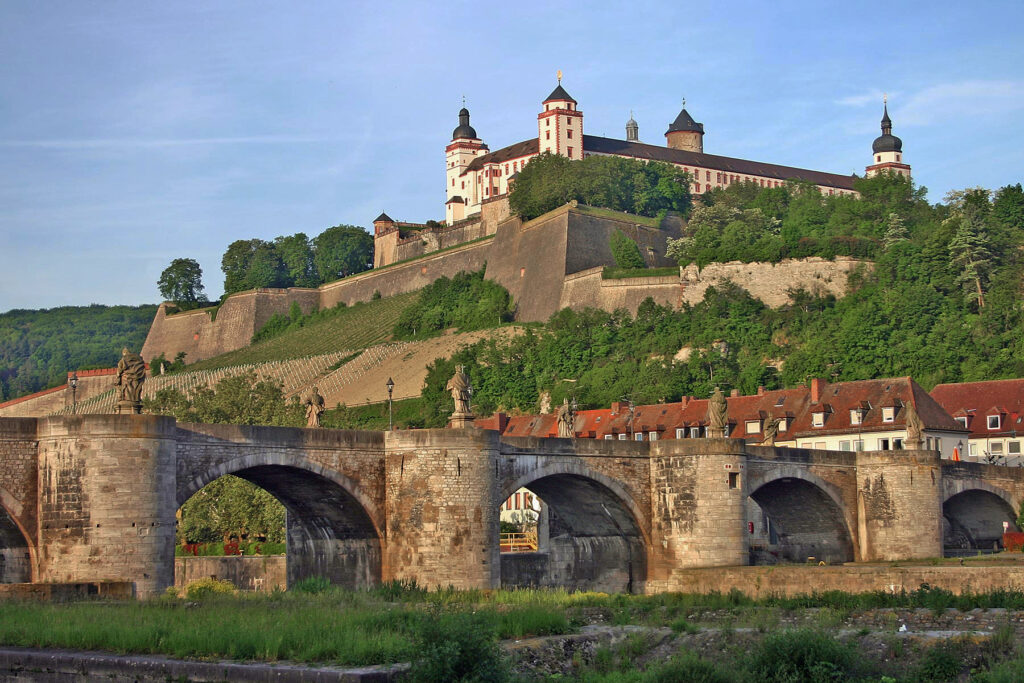
Würzburg sits along a bend in the Main River where Franconian wine country meets baroque grandeur. This university city of 130,000 doesn’t shout for attention like Munich or Nuremberg, but it rewards travelers who linger with one of Europe’s most spectacular palace interiors, a fortress that’s been standing for a millennium, and wine taverns where winemakers still pour their own Silvaner and Riesling.
The city was rebuilt after near-total destruction in 1945, but what rose from the rubble honors both its baroque past and its Franconian character. Between the Residenz’s frescoed ceilings and the vineyard-covered Marienberg hill, Würzburg offers a concentrated dose of everything that makes this corner of Bavaria compelling.
The Residenz: Tiepolo’s Masterpiece
The Würzburg Residenz stands as one of southern Germany’s finest baroque palaces, built between 1720 and 1744 for the prince-bishops who ruled here. But it’s the staircase that stops everyone cold. Giovanni Battista Tiepolo’s ceiling fresco—the largest in the world—sprawls across 600 square meters of plaster, depicting the four continents known to 18th-century Europe in a riot of color, allegory, and theatrical perspective.
The guided tour (available in English) takes you through the Imperial Hall, the Mirror Cabinet with its delicate rococo plasterwork, and the court chapel. Spring through fall, the palace hosts concerts in the rooms where Mozart once performed at age seven. The gardens behind the palace, laid out in formal French style, are free to wander and make an ideal spot for a break between sightseeing.
Entry costs €9 for adults, €8 with a combination ticket to the Marienberg Fortress museum. The palace is closed Mondays from November through March. Get there when it opens at 9:00 AM to beat the tour groups.
Marienberg Fortress and the Frankenwein Trail
Across the Old Main Bridge, Marienberg Fortress crowns a vine-covered hill that’s been fortified since 1000 AD. The walk up takes about 20 minutes through steep vineyard paths, or you can catch bus 9 from the Residenz. The fortress itself houses the Mainfränkisches Museum, where Tilman Riemenschneider’s wood sculptures—carved here in Würzburg during the early 1500s—fill quiet galleries with late Gothic grace.
But the real draw is the view. From the fortress ramparts, the entire city spreads below: the Residenz’s copper domes, the twin spires of the Neumünster church, and the Main River curving through neighborhoods old and new. The vineyards climbing the slopes around you produce the Stein wines that made Würzburg famous—dry, mineral Silvaner that pairs with everything from Schäufele (Franconian pork shoulder) to river fish.
The Frankenwein Panoramaweg hiking trail loops through these same vineyards, starting at the fortress and descending through the Stein and Innere Leiste vineyard sites. It’s a two-hour walk with interpretive signs explaining Franconian viticulture, and it ends conveniently near several wine taverns in the old town.
The Old Town and Its Wine Taverns
The Alte Mainbrücke, Würzburg’s pedestrian stone bridge dating to the 1470s, functions as the city’s living room on warm evenings. Locals gather on the bridge balustrades with bottles of Franconian wine in hand, watching the sunset light the fortress golden. The twelve baroque statues of saints lining the bridge survived the war and still keep watch over the scene.
Just off the bridge, the old town’s narrow lanes hide the Weinstuben and Heckenwirtschaften where Würzburg’s wine culture comes alive. Bürgerspital Weinstuben, run by a charitable foundation established in 1319, pours wines from its own 120-hectare estate. Juliusspital Weinstuben, equally historic, serves traditional Franconian dishes alongside its vineyard bottlings. Both occupy atmospheric vaulted cellars and garden courtyards.
For a more casual experience, try the Vinothek am Marktplatz, where you can taste through Franconian wines by the glass and take bottles home. The nearby Marktplatz itself hosts a farmers market on Wednesdays and Saturdays—a good spot to stock up on Bocksbeutel wine bottles (the squat, flask-shaped bottles unique to Franconia) and local cheese.
Getting There and Planning Your Visit
Würzburg sits on the main rail line between Frankfurt and Nuremberg, making it an easy stop on a Bavarian itinerary or a base for exploring the Romantic Road, which officially begins here. Direct ICE trains from Frankfurt take 70 minutes; from Nuremberg it’s just over an hour. The old town and Residenz are a 15-minute walk from the train station, or take tram 1, 2, 3, or 5.
May through September brings the warmest weather and the liveliest atmosphere on the Old Main Bridge, but it also means crowds at the Residenz. Late April, when the vineyards green up, and September, during harvest season, offer ideal conditions. The Africa Festival, held annually in May along the Main riverbank, draws huge crowds—book accommodation well ahead if you’re visiting then.
Plan a full day to cover the Residenz, fortress, and old town at a comfortable pace, or stay two nights to include a proper vineyard walk and unhurried wine tavern dinners. Würzburg also makes a perfect day trip from either Frankfurt or Nuremberg if your schedule is tight.
Want more Germany stories like this delivered to your inbox? Subscribe to the Love Germany newsletter—one short story a day, no fluff, just the country beyond the guidebooks.
Tours & experiences in Germany


Powered by Viator. Some links are affiliate links — we may earn a small commission at no extra cost to you.