
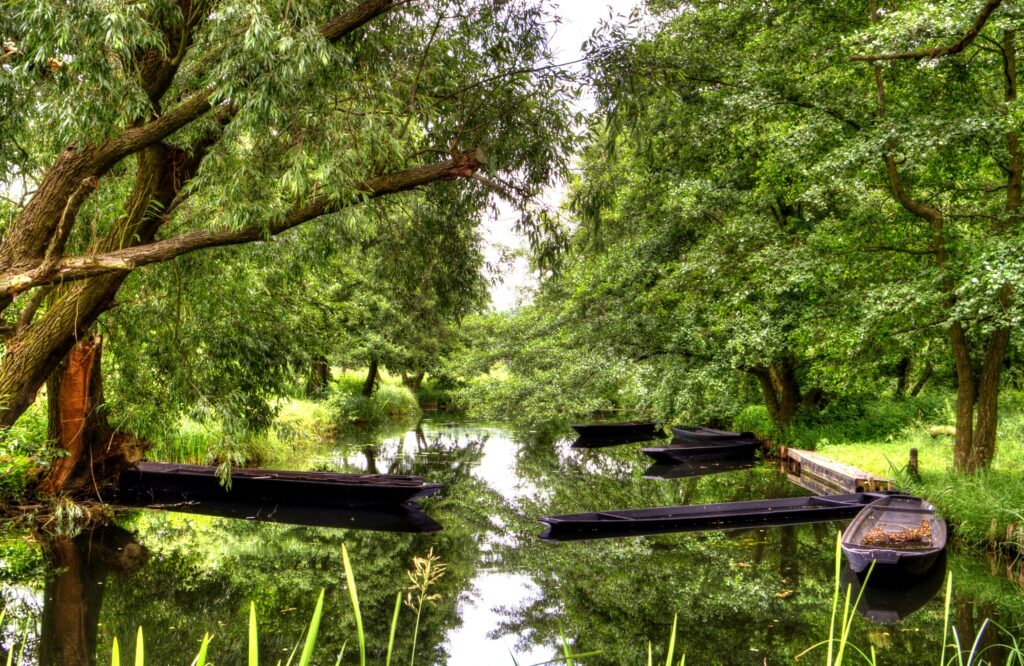
An hour southeast of Berlin, the Spree River dissolves into hundreds of tree-lined channels that weave through farmland, forest, and villages so remote that mail still arrives by boat. The Spreewald—a UNESCO Biosphere Reserve spread across 475 square kilometers of Brandenburg—feels like another country entirely, where farmers pole wooden punts through the canals, Sorbian folk traditions endure, and cucumbers are treated with the reverence other regions reserve for wine.
This is Germany’s most watery landscape, and the only way to truly see it is from the water.
Where the Spree Splits Into a Thousand Streams
The Spreewald’s labyrinth of waterways—over 1,500 kilometers in total—was shaped by Ice Age meltwater and centuries of human engineering. What you see today is part nature, part tradition: a network of channels (called Fließe) that connect villages, fields, and forest, maintained for transport, irrigation, and tourism since the Middle Ages.
The main gateway towns are Lübbenau and Lübben, both easily reached by regional train from Berlin. Lübbenau is larger and more developed, with plenty of boat rentals and tourist infrastructure. Lübben is quieter, smaller, and closer to the southern Unterspreewald, which sees fewer visitors. Both offer access to the canals, but the experience differs: Lübbenau puts you in the heart of the tourist Spreewald, while Lübben feels more remote.
For the deepest immersion, head to Lehde, a tiny hamlet just outside Lübbenau where cars can’t reach most houses. Here, residents still use punts for daily errands, and the open-air museum preserves traditional Sorbian farmhouses and tools.
Paddling Your Own Course
You can explore the Spreewald two ways: aboard a traditional guided punt (Kahnfahrt) or by renting your own canoe or kayak. The punts are charming and effortless—you sit back while a guide poles you through the channels, narrating in German (sometimes English) about local history, wildlife, and pickle lore. Tours range from one to four hours and leave from Lübbenau’s harbor throughout the day, April through October.
But renting a kayak or canoe gives you freedom. Dozens of outfitters in Lübbenau and Lübben rent boats by the hour or day, and the channels are well-marked with route numbers and distance signs. The water is calm, the current gentle, and you can stop wherever you like—at a riverside Gasthaus for lunch, a swimming spot under the trees, or simply to drift and listen to woodpeckers and orioles.
A popular half-day route from Lübbenau takes you south through Lehde, loops through narrow forest channels, and returns via the Hauptspree (the main channel). For a longer paddle, follow the marked route toward Raddusch or Burg, stopping at canal-side inns along the way. In summer, pack a swimsuit—there are plenty of spots to slip into the cool, tea-colored water.
Pickles, Sorbian Villages, and Canal-Side Meals
The Spreewald is Germany’s pickle capital, and you’ll see evidence everywhere: roadside stands selling jars of Spreewälder Gurken, farms advertising their pickle varieties, and restaurants serving them alongside every meal. These aren’t ordinary pickles—they’re protected by EU law, brined with dill, mustard seed, and horseradish, and utterly addictive. Stop at Rabe in Lehde or Gurken-Paule in Lübbenau to taste (and buy) the best.
The region is also home to the Sorbs, a Slavic minority who’ve lived here for over a thousand years. You’ll hear Sorbian (a language related to Polish and Czech) spoken in villages like Burg and see bilingual signs throughout the region. Sorbian traditions—especially elaborate Easter egg painting and folk costumes—are still very much alive, and small museums in Lübbenau and Burg tell the story.
For lunch, paddle up to a Spreewaldgasthaus. These canal-side inns serve hearty regional dishes: Leinöl mit Pellkartoffeln (boiled potatoes with linseed oil and quark), smoked eel, and Flammkuchen topped with Spreewald pickles. Try Wotschofska in Lehde, where you can moor your boat right at the terrace, or Landhaus Schloss Lubbenau, a more refined option with a garden and regional wine list.
When to Visit and How to Get There
The Spreewald shines from late April through September. May and June bring wildflowers, singing birds, and fewer crowds. July and August are warmest and busiest—book boats ahead on weekends. September offers golden light, mushroom foraging, and the pickle harvest in full swing. In winter, most businesses close, though a few punts run Christmas tours when the canals freeze into skating lanes.
From Berlin, regional trains (RE2 or RE24) run hourly to Lübbenau (about 70 minutes) and Lübben (80 minutes). You can also drive—it’s an easy hour down the A13. Once you’re there, you won’t need a car; everything is reached by boat, bike, or foot.
Bring sun protection, insect repellent (mosquitoes love the canals in summer), and a drybag for valuables. Wear shoes that can get wet. And budget time to get a little lost—the Spreewald rewards wandering.
Want more stories like this? Subscribe to the Love Germany newsletter and get one short story a day, delivered straight to your inbox—no fluff, just the Germany you came to discover.
Tours & experiences in Germany


Powered by Viator. Some links are affiliate links — we may earn a small commission at no extra cost to you.