
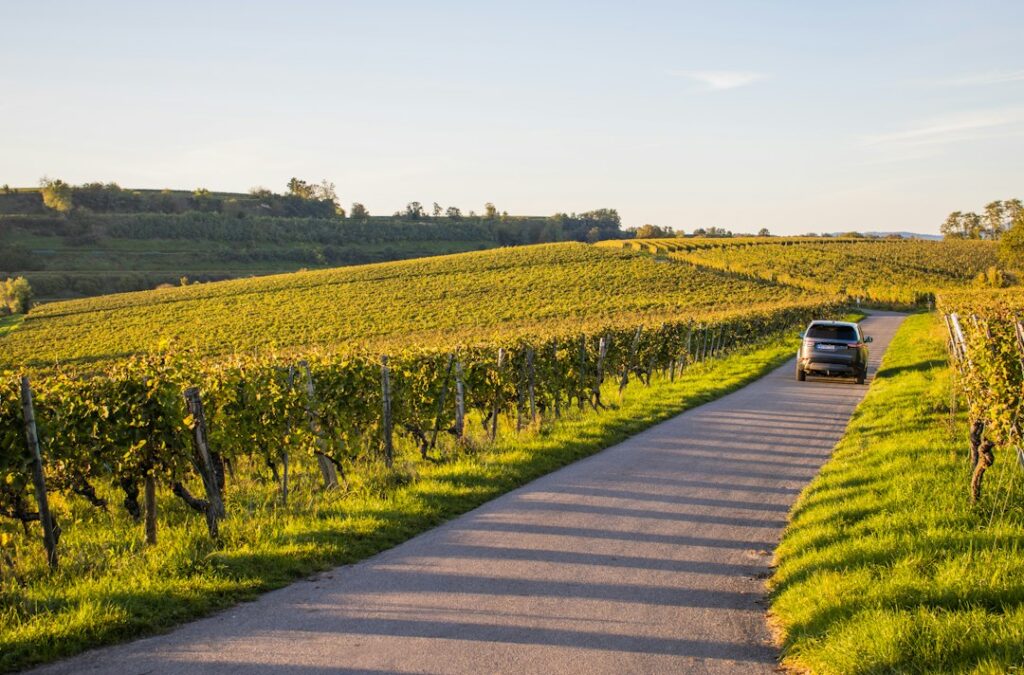
The Mosel Wine Route stretches 242 kilometers from Trier to Koblenz, following one of Europe’s most serpentine rivers through terraced vineyards that seem to defy gravity. Unlike the busier Rhine, the Mosel keeps its medieval pace—Roman ruins, slate-roofed wine villages, and family cellars where the winemaker still pours.
This is Germany’s oldest wine region, where Riesling reaches its apex on slopes so steep they’re worked entirely by hand. The drive rewards patience: hairpin curves, narrow village lanes, and riverside roads built when horses set the speed limit.
The Route: Trier to Koblenz
Start in Trier, where Roman emperors built the Porta Nigra and planted the first vines. The B53 hugs the river’s right bank through Schweich and Mehring, but the more scenic route crosses to the left bank via Longuich. Here the road climbs above the river, giving you the vineyard views that make this drive memorable.
At Trittenheim, the river makes its first dramatic loop. The village sits on the inside curve, vineyards rising in near-vertical terraces behind it. Stop at Weingut Clüsserath—the Rieslings here taste like wet slate and green apples, exactly what Mosel wine should be.
Bernkastel-Kues is the route’s tourist hub, and for good reason. The Marktplatz is a postcard of half-timbered houses leaning on each other like old friends. Park outside the center—the lanes are medieval-narrow—and walk to the Renaissance Rathaus and the wine taverns tucked into cellars under the square.
Between Bernkastel and Traben-Trarbach, the valley narrows. This stretch, called the Middle Mosel, holds the region’s most celebrated vineyards: Wehlener Sonnenuhr, Ürziger Würzgarten, Erdener Treppchen. Each village has a Weinstube where you can taste the slope above you in a glass.
Traben-Trarbach was once Europe’s second-largest wine trading center after Bordeaux. The Art Nouveau villas lining the riverfront are relics of that Belle Époque wealth. Cross the bridge to Traben and visit the Mittelmosel Museum for context on what you’re driving through.
The final section from Cochem to Koblenz opens up. Cochem’s Reichsburg castle towers over the town like something from a fairy tale—because it is, sort of. The 19th-century reconstruction is romantic fantasy, but the views from the ramparts are real. The valley widens near Koblenz, where the Mosel empties into the Rhine at the Deutsches Eck.
Best Time to Drive
Late April through early June offers green slopes and spring blossoms without the crowds. September and October bring harvest season—the vineyards glow gold and amber, and every village celebrates with a Weinfest. Sunday mornings in harvest season are the quietest, though some wine estates close on Sundays.
Avoid summer weekends if you can. The Mosel Wine Route sees heavy traffic from Dutch and Belgian tourists, and parking in villages like Bernkastel becomes a test of patience. Midweek in shoulder season is ideal.
Where to Stop and Taste
The Mosel has over 4,000 wine estates, most family-run and open for tastings by appointment or walk-in during posted hours. Look for signs reading “Weinprobe” or “Probierstube.” A tasting typically costs €5 to €10 for four to six wines.
In Ürzig, Weingut Mönchhof produces textbook Mosel Rieslings from the red slate Würzgarten vineyard. The tasting room overlooks the vines. In Erden, stop at Weingut Dr. Loosen—Erni Loosen is a legend here, and the old-vine Rieslings justify the reputation.
Don’t skip the cooperatives. The Zentralkellerei Mosel in Bernkastel-Kues represents 1,700 small growers and offers tastings that showcase the valley’s diversity. It’s less romantic than a small family cellar, but the quality is solid and the prices are kind.
For lunch with a view, Weinhaus Halfenstube in Kröv serves Flammkuchen and regional dishes on a terrace overlooking the river loop. Pair it with a local Riesling Spätlese—slightly sweet, balanced by electric acidity.
Practical Tips
The B53 is narrow and slow—plan on averaging 40 kilometers per hour, not highway speeds. Parking in villages is limited; arrive before noon or after 4 p.m. to avoid the worst of it. Many villages have small lots along the river; they fill fast in high season.
If you’re tasting, designate a driver or consider staying overnight in Bernkastel, Cochem, or Zell. The Mosel has excellent small hotels and guesthouses, many run by wine estates that offer rooms above the cellar.
The route is well-marked with brown “Deutsche Weinstrasse” signs, but a good map or GPS helps. Villages often have one-way systems that aren’t obvious until you’re committed. Mobile reception is generally good, though it drops in the narrowest valley sections.
Fill up on fuel before you start—gas stations are sparse between Bernkastel and Cochem. Trier and Koblenz have the most services; in between, you’re in wine country, not highway corridor.
The entire drive takes three to four hours without stops. With tastings, meals, and exploring, budget a full day or—better—two. The Mosel rewards slow travel.
Want more stories like this in your inbox? Subscribe to the Love Germany newsletter and get one short story a day—the Germany beyond the guidebooks, delivered every morning.
Tours & experiences in Germany


Powered by Viator. Some links are affiliate links — we may earn a small commission at no extra cost to you.