
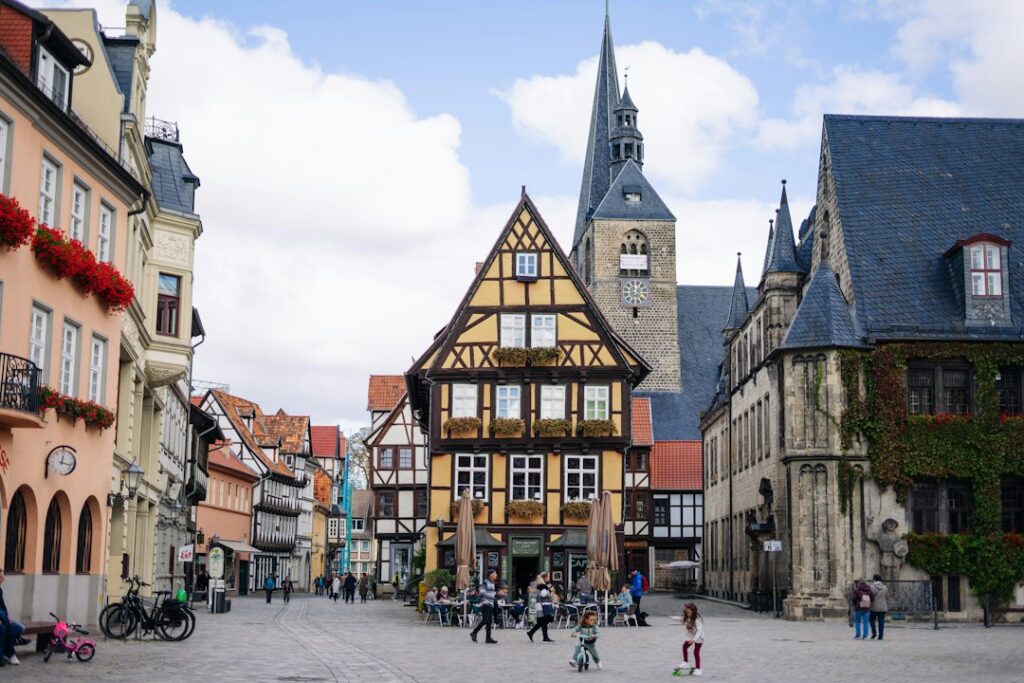
Quedlinburg sits at the northern edge of the Harz Mountains with a claim few German towns can match: more than 2,000 half-timbered houses, the largest concentration in the country, spanning from the 14th to the 19th century. The entire Old Town earned UNESCO World Heritage status in 1994, and a morning spent walking its cobbled lanes feels like stepping back through eight centuries of German architectural history.
This isn’t a place you rush through. The magic of Quedlinburg reveals itself slowly—in the carved beams above doorways, the narrow alleys that open suddenly onto sun-filled squares, and the painted facades that shift from soft ochre to deep red as the light changes.
The Market Square and Town Hall
Start at the Marktplatz, the town’s beating heart since the Middle Ages. The Renaissance town hall dominates the square, its statue of Roland standing guard since 1426. On market days—Wednesday and Saturday mornings—the square fills with vendors selling Harz honey, smoked sausages, and seasonal produce.
The most photographed building here is the Marktschlösschen, a 1615 merchant house with elaborate carved brackets and corner oriels. Its ground floor now houses a café where you can sit outside and watch the square come to life over coffee and Baumkuchen, the layered cake that’s a regional specialty.
Look for house number 13-14 on the north side of the square. The Zur Rose pharmacy has occupied this 1480 timber-frame building for more than 300 years, making it one of Germany’s oldest continuously operating pharmacies.
Climbing to the Castle Hill
From the market square, head west up Schlossberg, the steep cobbled lane that leads to Quedlinburg Castle and the Collegiate Church of St. Servatius. The climb takes about ten minutes, but pause halfway at the terrace viewpoint—the roofscape of red tiles and half-timbered gables stretching toward the Harz peaks is worth the stop.
The Stiftskirche St. Servatius dates to the 12th century and houses the treasury, where reliquaries and illuminated manuscripts from the Ottonian era gleam in climate-controlled cases. The Romanesque crypt below holds the tombs of King Henry I and Queen Mathilde, founders of the medieval German state.
The church treasury opens Tuesday through Saturday from 10:00 to 18:00, and Sundays from 12:00 to 18:00. Admission is €6, and an audio guide in English is included.
The Finkenherd Quarter
Back down the hill, make your way to the Finkenherd neighborhood, the oldest intact residential quarter in Quedlinburg. The streets here—Wordgasse, Pölle, and Breite Straße—are lined with 14th- and 15th-century houses so well preserved that film crews regularly use them as medieval backdrops.
Stop at Wordgasse 3, the oldest half-timbered house in central Germany still standing. Built around 1310, its oak beams have weathered more than 700 winters. A small plaque by the door marks its age, but otherwise it blends seamlessly into the streetscape—locals still live here.
At Breite Straße 39, the Ständerbau Museum occupies a 1310 timber-frame house and explains the construction techniques that allowed these buildings to survive centuries of fire, war, and weather. The admission is €3, and the exhibits are labeled in German and English.
Practical Details and Timing
Quedlinburg is an easy 90-minute train ride from Berlin or Leipzig, making it a perfect day trip. Trains from Berlin require one change in Magdeburg or Halberstadt; from Leipzig, change in Halle. The station sits about a kilometer from the Old Town—a pleasant 15-minute walk along tree-lined streets, or take the local bus.
The best time to visit is May through September, when cafés spill onto the squares and window boxes overflow with geraniums. Early morning, before tour groups arrive around 10:00, offers the most atmospheric light for photography and the quietest streets for wandering.
Wear comfortable walking shoes. Quedlinburg’s cobblestones are original—uneven, charming, and murder on thin-soled sneakers. The hills up to the castle and through the Finkenherd are steep enough that you’ll feel them in your calves.
For lunch, try Brauhaus Lüdde on Blasiistraße, where they brew their own beer in copper kettles visible from the dining room and serve hearty Harz fare—venison goulash, potato dumplings, and herb-crusted trout from local streams.
If you want to extend your visit, Quedlinburg makes an excellent base for exploring the Harz. Hiking trails into the mountains start just outside town, and the narrow-gauge steam railway to Thale departs from the main station.
Want more stories from Germany’s most beautiful towns, castles, and hidden corners? Subscribe to the Love Germany newsletter and get one short story a day, straight to your inbox.
Tours & experiences in Germany


Powered by Viator. Some links are affiliate links — we may earn a small commission at no extra cost to you.