
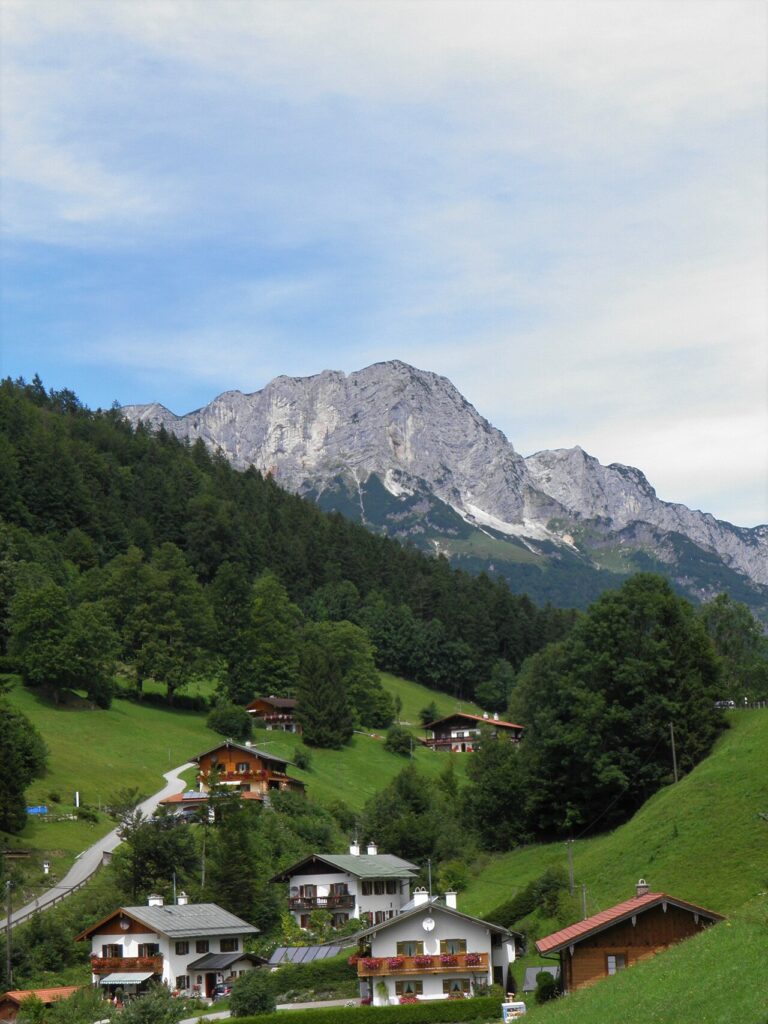
Tucked into Germany’s southeastern corner where Bavaria meets Austria, Berchtesgaden National Park protects 210 square kilometers of raw alpine beauty. This is Germany at its most vertical: limestone walls soaring above glacial lakes, chamois picking their way across scree slopes, and hiking trails that reward effort with views stretching to the Dachstein massif.
Unlike the gentler peaks of the Black Forest or the rolling Allgäu, Berchtesgaden delivers high-alpine drama. The park shares geology and ecosystems with the Austrian Alps, creating landscapes that feel more Swiss than Schwarzwald. If you’re after Germany’s most stunning mountain scenery, this is where you’ll find it.
Königssee: The Fjord That Isn’t
The park’s centerpiece is Königssee, an eight-kilometer lake carved by glaciers and hemmed in by near-vertical walls. Its emerald-green water—among the cleanest in Germany—reflects the Watzmann’s east face, a 1,800-meter wall of limestone that dominates the western shore.
Only electric boats have been allowed on Königssee since 1909, preserving the silence that makes the lake famous. Board at Schönau am Königssee and glide south toward St. Bartholomä, a picturesque pilgrimage church with onion domes set against the mountain wall. Boat captains stop mid-lake to play a trumpet; listen as the echo bounces off the Watzmann—it’s touristy, yes, but genuinely moving.
At St. Bartholomä, disembark for a meal of fresh trout at the former hunting lodge, now a restaurant. From here, trails lead to the Eiskapelle, an ice cave at the base of the Watzmann that persists through most summers, and to the lake’s southern end at Salet, where a fifteen-minute walk brings you to Obersee, even more remote and equally stunning.
The boats run year-round, though winter schedules are limited. Go early morning in summer to beat the crowds, or visit in autumn when larches turn gold against the limestone.
The Watzmann: Germany’s Most Storied Peak
At 2,713 meters, the Watzmann isn’t Germany’s highest mountain—that’s the Zugspitze—but it’s arguably the most dramatic. The east face looms over Königssee like a natural fortress, and the main ridge connects three summits: Hocheck, Mittelspitze, and Südspitze.
The Watzmann traverse is one of the classic alpine routes in the Eastern Alps, but it’s serious mountaineering, not a hike—exposed scrambling, 2,200 meters of ascent, and a very long day. Most visitors settle for admiring it from below or tackling the Watzmannhaus hut approach, a strenuous but non-technical climb that delivers extraordinary views.
For a taste of high-alpine terrain without the commitment, hike from St. Bartholomä to the Wasseralm and onward toward the Watzmann cirque. You’ll gain altitude through alpine meadows—brilliant with wildflowers in June and July—and get close enough to appreciate the scale of the east face.
Hintersee and the Zauberwald
West of Königssee lies Hintersee, a smaller lake surrounded by forest and framed by the Hochkalter and Reiter Alpe ranges. The Zauberwald, or “Magic Forest,” is a mossy wonderland of moss-covered boulders, twisted trees, and cascading streams—the result of a massive rockslide centuries ago.
A gentle two-kilometer loop circles the lake and dips through the Zauberwald. It’s accessible for families and makes a perfect counterpoint to the more demanding trails around Königssee. The reflections on Hintersee are best in early morning when mist rises off the water.
From Hintersee, trails climb to the Blaueishütte, a mountain hut beneath the Hochkalter’s north face where Germany’s northernmost glacier clings to life, and to the Gotzenalm, a traditional alpine pasture with a hut serving Brotzeit and views across to the Watzmann.
Practical Tips for Visiting
Berchtesgaden town is the gateway, connected by train from Munich via Freilassing (around 2.5 hours). From Berchtesgaden, buses run to Königssee (twenty minutes) and Hintersee (fifteen minutes). Parking at the lakes fills early on summer weekends; public transport is the smarter choice.
Accommodation ranges from Berchtesgaden’s hotels and guesthouses to mountain huts for overnight treks. Book huts well ahead in summer—they fill fast. The Watzmannhaus and Carl-von-Stahl-Haus are the most popular.
Late May through October is the prime season. Snow lingers on higher trails into June, and huts typically open mid-June through September. September offers stable weather, fewer crowds, and the first autumn colors. Winter transforms the park into a Nordic skiing and snowshoeing destination, though avalanche risk closes many high trails.
Download trail maps from the national park website and check conditions before heading out. Weather changes fast in the mountains; carry layers, water, and snacks even on shorter hikes. Trails are well-marked but often steep and rocky—boots with ankle support are essential.
Beyond the Trails
The park isn’t just about hiking. Rock climbers flock to the Watzmann and surrounding peaks for multi-pitch routes on solid limestone. Paragliders launch from Jenner, the mountain above Königssee, for flights over the lake. In winter, cross-country skiers trace routes through the Klausbachtal, one of the park’s quietest valleys.
For a less strenuous adventure, ride the cable car up Jenner (1,874 meters) for panoramic views without the sweat. The summit restaurant serves hearty Bavarian fare, and short walks lead to viewpoints over Königssee and deep into Austria.
The town of Berchtesgaden itself deserves a few hours: the old market square, the Schloss with its museum, and the Salzbergwerk, a working salt mine offering underground tours that trace the region’s mining heritage back to medieval times.
Berchtesgaden National Park offers a side of Germany many travelers miss—raw, vertical, and utterly spectacular. Whether you’re circumnavigating Königssee, summiting a peak, or simply wandering the Zauberwald, you’re experiencing the Alps at their Bavarian best.
Want more stories from Germany’s mountains, valleys, and hidden corners? Subscribe to the Love Germany newsletter and get one short story a day, delivered to your inbox each morning.
Tours & experiences in Germany


Powered by Viator. Some links are affiliate links — we may earn a small commission at no extra cost to you.