
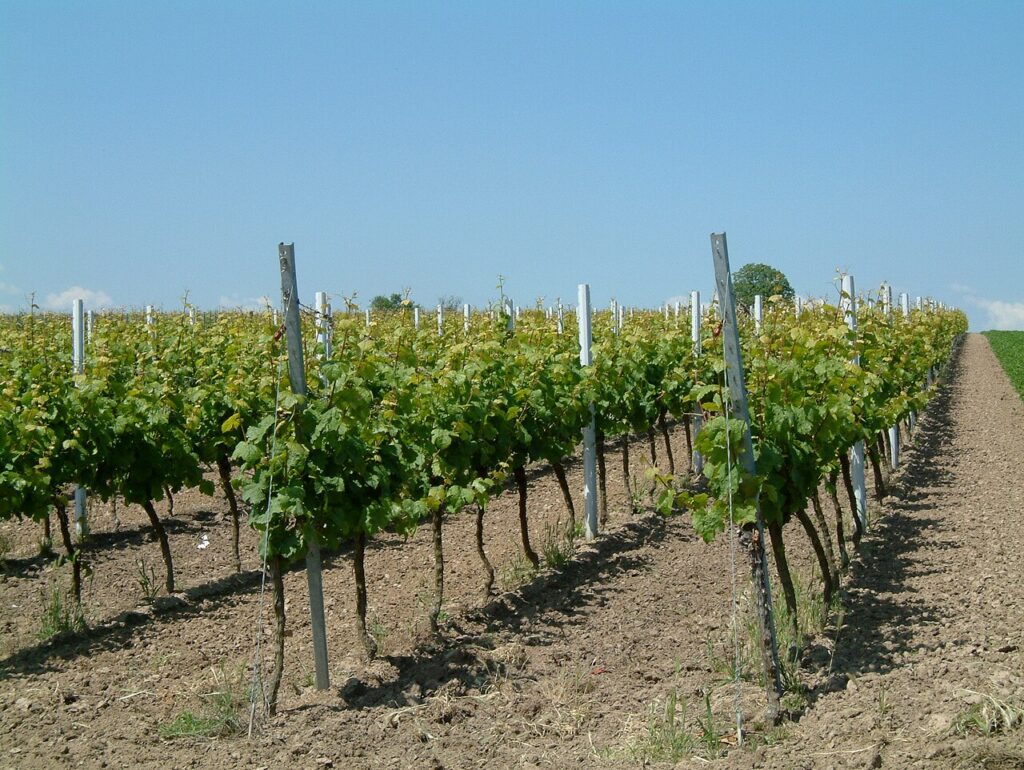
The Rheingau is Germany’s Riesling heartland. This compact wine region stretches just 30 kilometers along the Rhine’s northern bank between Wiesbaden and Lorch, but it produces some of the country’s most celebrated white wines. The south-facing slopes, protected by the Taunus hills, create ideal conditions for the noble grape that’s been grown here since the Middle Ages.
Unlike the Moselle’s steep slate or the Pfalz’s sandstone, the Rheingau’s combination of loess, clay, and quartzite produces Rieslings with remarkable structure and aging potential. The region’s wines tend toward elegance rather than power—mineral-driven, with citrus and stone fruit notes that deepen into honey and petrol with age.
Kloster Eberbach and the Steinberg Vineyard
Start at Kloster Eberbach, the 12th-century Cistercian monastery near Eltville that served as the region’s winemaking center for centuries. The monks planted the Steinberg, a walled vineyard that remains one of Germany’s grand cru sites. Today the monastery hosts the state wine estate’s tasting room, where you can sample current vintages in the vaulted Cabinetkeller.
The Steinberg itself sits just uphill from the monastery. Walk through the stone archway into the 32-hectare vineyard—still enclosed by its original walls—where Riesling vines grow on terraced slopes. The estate produces several Steinberg bottlings, from dry Erstes Gewächs (first growth) to sweet Auslese. Tastings require advance booking, but the monastery grounds are open daily.
Rüdesheim’s Wine Estates and Drosselgasse
Rüdesheim am Rhein anchors the Rheingau’s western end, where the river bends sharply north and the vineyards climb steeply behind the town. The Berg Schlossberg and Berg Rottland sites produce some of the region’s most powerful Rieslings, with more body and ripeness than wines from the gentler slopes downriver.
Visit Weingut Georg Breuer, whose tasting room on Grabenstrasse offers flights focused on single-vineyard expressions. The estate pioneered dry Riesling in the Rheingau when most producers still favored residual sweetness. Book ahead for a seated tasting with cheese and bread.
For a more casual experience, head to the Drosselgasse, the cobblestoned alley lined with wine taverns. It’s touristy, yes, but the local wines flow freely and most establishments pour Rheingau Riesling by the glass. Try Drosselhof or Lindenwirt for outdoor tables and straightforward regional pours.
Eltville and Hattenheim: Estate Visits Along the Rhine
Between Rüdesheim and Wiesbaden, the riverside towns of Eltville and Hattenheim offer quieter tasting experiences. Eltville’s Gutenberg Castle overlooks the Rhine, and the town square hosts a wine market most Saturday mornings from May through October.
In Hattenheim, Weingut Peter Jakob Kühn practices biodynamic viticulture on some of the Rheingau’s steepest slopes. The family estate welcomes visitors to their historic tasting room on Mühlgasse—call ahead to arrange a tour that includes the cellar and vineyard walk. Their Rieslings are precise and mineral, fermented with native yeasts and aged in traditional Rheingau Stückfass barrels.
Nearby, Schloss Johannisberg rises above the vineyards on a prominent hill. This princely estate claims to have discovered spätlese (late harvest) wine in 1775 when a delayed courier arrived too late to authorize the harvest. The resulting wines, made from partially botrytized grapes, revealed new dimensions of sweetness and complexity. Today you can taste the estate’s range in the Schlosscafé, with panoramic views across the Rhine valley.
Practical Tips for Visiting the Rheingau
The Rheingau is easily reached from Frankfurt—trains from Frankfurt Hauptbahnhof to Wiesbaden or Rüdesheim take 45 minutes to an hour. The Rheinsteig hiking trail connects the wine towns, offering vineyard walks with Rhine views. Spring brings white asparagus season and blooming vines; autumn delivers harvest and federweisser (new wine).
Most estates require advance reservations for tastings, especially on weekends. Email or call a few days ahead. Expect to pay €15–30 for a seated tasting of four to six wines. Many wineries close on Sundays.
The regional wine cooperative in Eltville, the Rheingauer Winzergenossenschaft, offers a good introduction to the range of local producers. Their tasting room on Wallufer Strasse pours wines from 200 member estates, providing a broad overview before you commit to specific domaines.
If you love German wine and travel, subscribe to the Love Germany newsletter. We send one short story about Germany to your inbox each day—castles, regions, food, festivals, and the places that make this country unforgettable.
Tours & experiences in Germany


Powered by Viator. Some links are affiliate links — we may earn a small commission at no extra cost to you.