
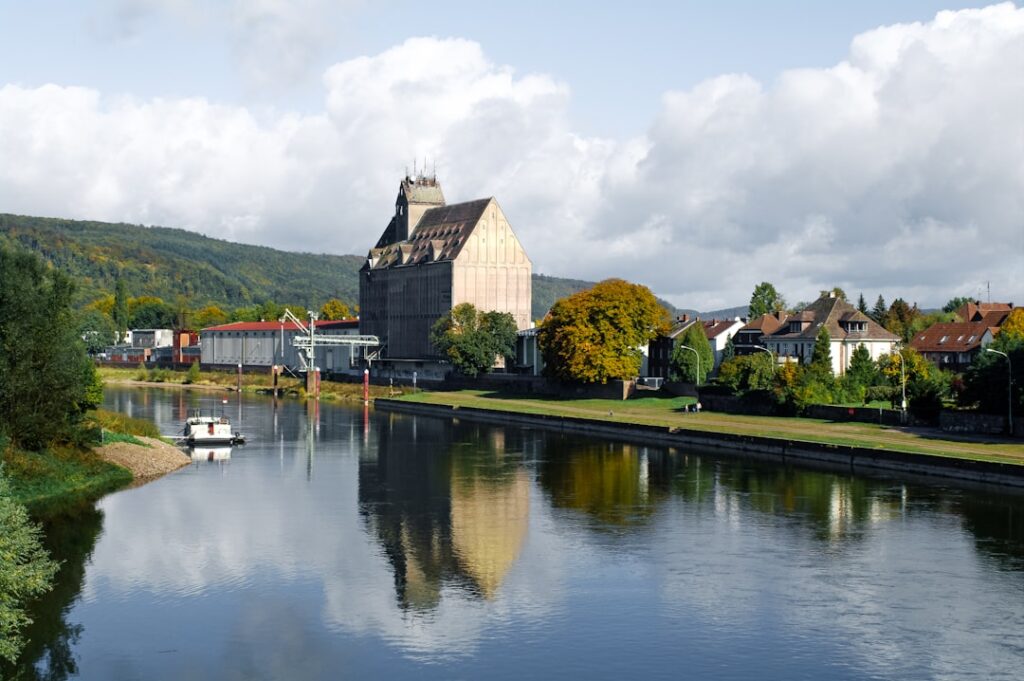
Most people know Hamelin (Hameln in German) as the setting for the Pied Piper legend, where a mysterious musician led the town’s children away after the townspeople refused to pay him for ridding them of rats. But while the legend draws visitors here, it’s the beautifully preserved Weser Renaissance architecture and the town’s genuine medieval charm that make them stay.
This Lower Saxon town on the Weser River, about 45 minutes southwest of Hanover, is one of Germany’s finest examples of 16th and 17th-century architecture, with elaborately decorated gabled houses lining cobbled streets that have barely changed in 400 years.
The Old Town: Weser Renaissance at Its Best
Hamelin’s Altstadt is a compact grid of streets where nearly every building tells a story. The most famous is the Rattenfängerhaus (Rat Catcher’s House) at Osterstraße 28, built in 1602 and covered in intricate stone carvings and ornamental scrollwork typical of Weser Renaissance style. Despite its name, it has no actual connection to the Pied Piper legend—it was built centuries after the events supposedly took place in 1284.
Walk down Osterstraße, the main pedestrian street, and you’ll pass the Dempterhaus and the Leisthaus, both showcasing the elaborate facades and decorative elements that define this architectural style: pyramid-shaped pinnacles, carved rosettes, and bands of ornamental stonework.
The Marktkirche St. Nicolai, a Gothic hall church dating to the 13th century, anchors the market square. Its tower offers views over the red-tiled rooftops of the old town and the Weser Valley beyond. The church’s simple interior is a contrast to the ornate exteriors outside, but the stained glass and vaulted ceiling are worth a look.
Following the Pied Piper Trail
The town embraces its legendary past without letting it overwhelm the authentic historical experience. From May through September, actors perform the Pied Piper story as a free open-air play every Sunday at noon on the Hochzeitshaus terrace. The Hochzeitshaus itself, built between 1610 and 1617, features a glockenspiel that depicts the legend three times daily at 1:05 p.m., 3:35 p.m., and 5:35 p.m.
Embedded in the pavement, a line of white rats leads visitors through the old town past key sites. It’s a clever way to explore without feeling like you’re being led through a theme park—the route takes you past the most beautiful buildings while telling the story in small doses.
The Museum Hameln on Osterstraße provides historical context to the legend, including theories that it may reference a children’s crusade, medieval emigration, or a deadly plague. The museum also covers the town’s actual history as a prosperous milling and trading center.
The Weser River and Beyond
Hamelin sits on the Weser Cycle Route, one of Germany’s most popular long-distance bike paths. Even if you’re not cycling the full 515-kilometer route from Hann. Münden to the North Sea, the riverside promenade makes for a pleasant walk, with views of the Weserbergland hills rising on both sides of the valley.
The Bürgergarten, just across the Weser bridge, is a green space where locals picnic and families let children play. From here, you can see the entire old town skyline, with church spires and Renaissance gables rising above the trees.
For a longer excursion, the nearby Klüt, a forested hill about 3 kilometers south of town, offers hiking trails and lookout points over the Weser Valley. The area is part of the Weserbergland Schaumburg-Hameln Nature Park, a landscape of rolling hills, forests, and half-timbered villages that gets far less attention than the more famous German nature destinations.
Practical Details
Hamelin is an easy day trip from Hanover—trains run several times an hour and take about 45 minutes. From the Hauptbahnhof, it’s a 10-minute walk to the old town center. If you’re driving, parking is available near the Bürgergarten and at the edge of the Altstadt.
The town is walkable end to end in 20 minutes, making it ideal for a half-day visit, though it’s pleasant enough to linger for lunch. Rattenfänger-Halle on Osterstraße serves solid regional dishes in a historic setting—try the Weser Valley trout or a schnitzel.
Visit on a Wednesday or Saturday morning when the weekly market fills the Pferdemarkt square with stalls selling produce, flowers, and baked goods. The atmosphere is decidedly local, with more residents shopping for vegetables than tourists buying souvenirs.
The Pied Piper season runs May through September, but the town is equally charming in the quieter months when you’ll have the streets largely to yourself. The Christmas market in December transforms the market square into a scene from a medieval fairy tale, though without the overcrowding of larger German cities.
Want more stories like this in your inbox? Subscribe to the Love Germany newsletter—one short story about Germany every day, from small towns to hidden traditions, delivered straight to you.
Tours & experiences in Germany


Powered by Viator. Some links are affiliate links — we may earn a small commission at no extra cost to you.