
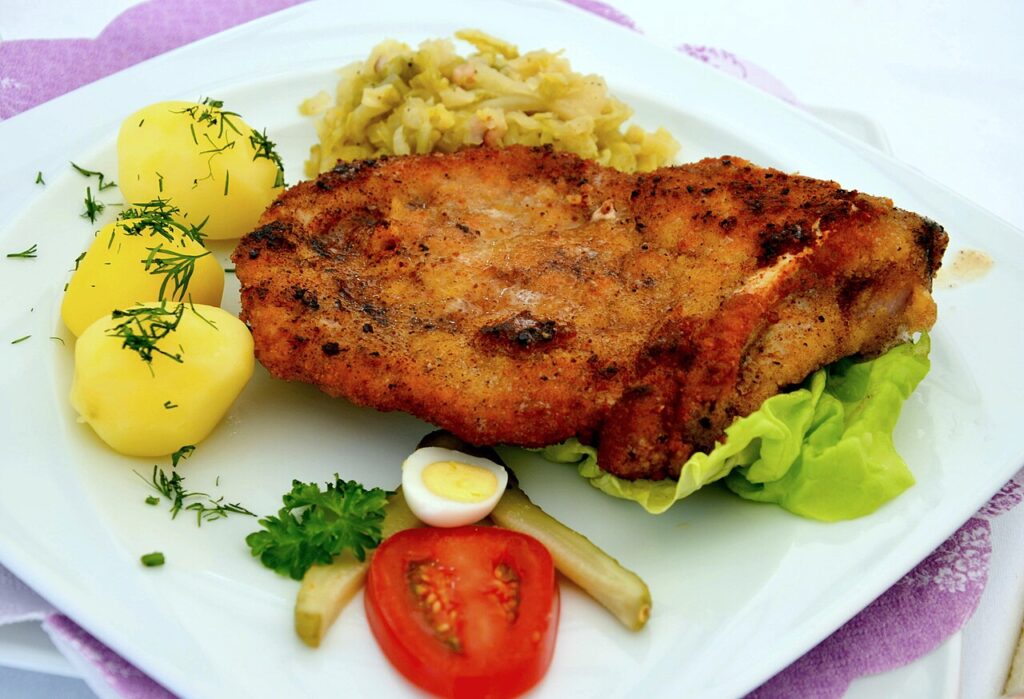
Walk into almost any German Gasthaus and you’ll find schnitzel on the menu. But not all schnitzels are created equal. The difference between a mediocre cutlet and an exceptional one comes down to three things: the meat, the breading, and the fat it’s fried in. Germany‘s best schnitzel makers guard their techniques like family secrets, and certain regions have built reputations on getting it exactly right.
Bavaria: The Pork Schnitzel Heartland
In Bavaria, schnitzel means pork. The Schweineschnitzel—a thin-pounded pork cutlet, breaded and fried golden—is the default option in Munich beer halls and country Gasthäuser from Garmisch-Partenkirchen to Regensburg. The key is in the pounding: a proper Bavarian schnitzel should be tender enough to cut with a fork, with a crisp, airy coating that doesn’t absorb grease.
Look for it served with Kartoffelsalat (potato salad) dressed in a light vinegar-and-oil blend, never mayo. A wedge of lemon is standard, and purists insist you squeeze it over the meat, not the breading. The Hofbräuhaus in Munich serves a reliable version to tourists, but locals head to smaller spots like Gaststätte Großmarkthalle near the wholesale market, where truck drivers and butchers eat before dawn.
In the Allgäu, you’ll sometimes find schnitzel made from local veal or even wild boar during hunting season. The mountain lodges around Oberstdorf serve theirs with Preiselbeeren (lingonberry jam), a sweet-tart counterpoint to the rich, fried crust.
Swabia and Baden: The Jägerschnitzel Variations
Head west into Baden-Württemberg and schnitzel takes on richer, saucier forms. Jägerschnitzel—hunter’s schnitzel—comes smothered in a creamy mushroom sauce made with Champignons, shallots, and a splash of white wine. In Stuttgart and Freiburg, it’s often served with Spätzle, the region’s signature egg noodles, which soak up the sauce better than any potato could.
The twist here is that the schnitzel itself is sometimes unbreaded, pan-fried in butter until just golden. This isn’t traditional Wiener Art (Vienna-style), but it’s deeply Swabian. The sauce is everything: a good Jägerschnitzel should have earthy, forest-floor depth, with enough cream to coat the back of a spoon but not drown the meat.
Another Swabian specialty is Rahmschnitzel, where the cutlet is finished in a sauce of cream, onions, and sometimes a touch of Dijon mustard. It’s comfort food at its most unapologetic, best eaten in a wood-paneled Gasthaus on a cold November evening.
The Wiener Schnitzel Debate
Technically, Wiener Schnitzel—the gold standard—is Austrian. But Germany has adopted it wholesale, and many of the country’s best versions are found not in Bavaria but in places like Hamburg, Berlin, and Frankfurt, where chefs trained in classical European techniques treat it with the reverence it deserves.
True Wiener Schnitzel must be made from veal, pounded until translucent, dredged in flour, egg, and breadcrumbs, then fried in clarified butter or lard until the coating puffs and separates slightly from the meat. The result should be light, almost delicate, with a faintly nutty flavor from the browning butter.
In Berlin, old-school restaurants in Charlottenburg and Prenzlauer Berg serve it the traditional way: on an oval plate, garnished simply with lemon and parsley, sometimes with a single anchovy and a caper for salt. No sauce. No nonsense.
The price difference between pork and veal schnitzel is significant—often double—but the texture and flavor are worth it for a special meal. If a menu lists “Schnitzel Wiener Art,” that’s code for pork prepared in the Viennese style, which is perfectly fine but not the same thing.
Where to Find It
Every region has its champions. In Munich, Wirtshaus in der Au serves a Schweineschnitzel so large it hangs over the plate. In Stuttgart, Weinstube Fröhlich pairs Jägerschnitzel with local Trollinger wine. In Hamburg, the historic Ratsweinkeller under the town hall offers both pork and veal versions, prepared with northern restraint.
Smaller towns often hide the best finds. In Bamberg, Schlenkerla—famous for its smoked beer—serves a schnitzel that picks up a faint smokiness from the wood-fired kitchen. In the Moselle village of Bernkastel-Kues, riverside Gasthäuser serve schnitzel with a side of Riesling-soaked mushrooms, a nod to the valley’s wine culture.
The best time to order schnitzel is lunch, when kitchens are at their peak and the cutlets are freshly pounded. Avoid the reheated dinner rush at touristy spots. And if you see “vom Schwein” or “vom Kalb” listed next to the price, that’s transparency—pork or veal, respectively. Good restaurants always specify.
Want more stories about Germany’s food traditions, hidden-gem restaurants, and the dishes locals actually eat? Subscribe to the Love Germany newsletter—one short story a day, straight to your inbox.
Tours & experiences in Germany


Powered by Viator. Some links are affiliate links — we may earn a small commission at no extra cost to you.