
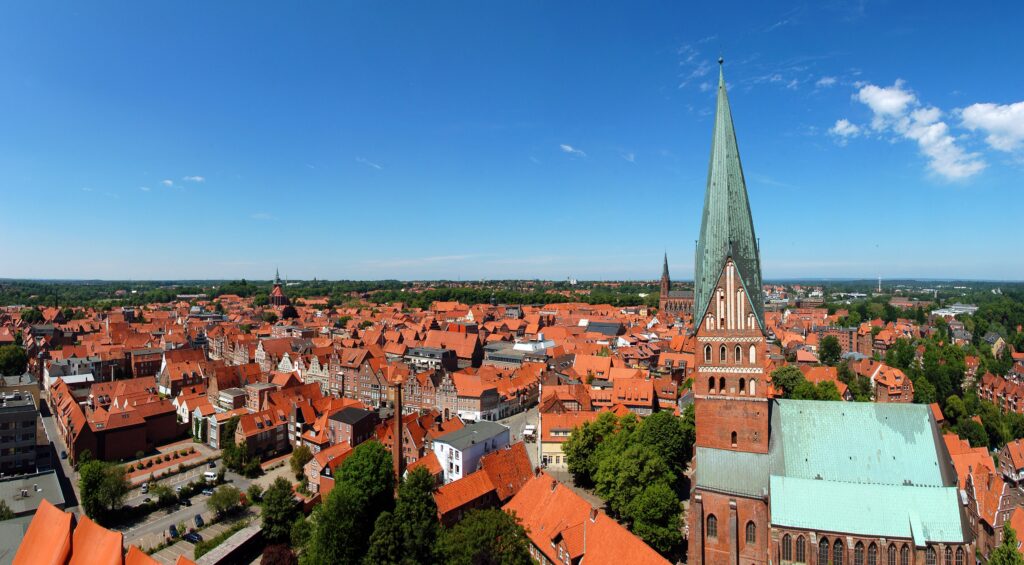
Lüneburg doesn’t announce itself the way Rothenburg does. There are no coach buses lined up outside the walls, no crowds jostling for the same photograph. Instead, this handsome brick town about 50 kilometers south of Hamburg reveals itself slowly: a crooked gable here, a church spire there, and everywhere the subtle lean of buildings whose foundations rest on centuries of salt mining below.
For nearly a thousand years, Lüneburg’s fortunes rose on a single commodity. The salt springs discovered here in the 10th century made the town wealthy beyond measure, a member of the Hanseatic League, and the supplier of the preservative that kept northern Europe’s fish edible through long winters. The mining stopped in 1980, but the legacy remains in every tilted facade and in the town’s remarkably intact medieval core.
The Am Sande: Lüneburg’s Sloping Heart
Start at the Am Sande, the town’s central square, where the ground itself seems unsure of level. The square slopes gently, and the buildings around it—Gothic brick townhouses with stepped gables—tilt at angles that would alarm a modern engineer. This isn’t neglect; it’s geology. Centuries of salt extraction created voids beneath the town, and the buildings settled accordingly. The effect is disorienting and charming in equal measure.
The most famous crooked building stands just off the square on the Waagestraße: the Schrøerstøer, a 16th-century inn that leans so dramatically it looks ready to topple. It hasn’t budged in 400 years. Inside, you can still have a beer at tables that require a spirit level.
The square itself is anchored by St. John’s Church (St. Johanniskirche), a Gothic brick masterpiece whose spire leans 2.2 meters off true vertical—more than Pisa, locals will tell you, though with less international fanfare. Climb the 108-meter tower on a clear day, and you’ll see the Lüneburg Heath stretching south toward the horizon.
The Old Town: Brick, Gables, and Hidden Courtyards
Lüneburg’s Altstadt is small enough to cover on foot in an afternoon, but worth a full day if you take time to wander the side streets. The Town Hall (Rathaus) on the Am Markt is one of northern Germany’s finest, with council chambers decorated in Renaissance wood paneling and Gothic frescoes. Guided tours run daily and reveal rooms that have been in continuous civic use since the 13th century.
Walk south toward the Ilmenau River and you’ll find the Old Harbour (Alter Hafen), where barges once loaded salt for the journey north to the Baltic. The old crane still stands, and the brick warehouses have been converted into cafés and apartments. It’s quieter here, especially in the early morning, and the reflections of the gabled houses in the river make for some of the town’s best photographs.
Don’t miss the Wasserviertel, the old millers’ and tanners’ quarter along the river’s edge. The narrow lanes and half-timbered houses here feel more intimate than the grand merchant facades around Am Sande. The Brewery Museum (Brauereimuseum) occupies a 15th-century brewery and tells the story of Lüneburg’s other great trade—beer. The town once had more than 80 breweries supplying thirsty Hanseatic merchants.
The German Salt Museum
To understand why Lüneburg looks the way it does, visit the German Salt Museum (Deutsches Salzmuseum) in the old salt works on Sülfmeisterstraße. The museum occupies the original industrial buildings where salt was extracted, boiled, and packed for export. The machinery is still in place—massive iron pans, wooden pumps, and the kind of Rube Goldberg apparatus that kept medieval industry running.
The exhibits trace salt’s role in everything from food preservation to currency, and explain how Lüneburg’s deposits formed when an ancient sea evaporated 250 million years ago. The geology lesson makes the town’s tilting buildings suddenly make sense. Allow at least an hour, more if you’re interested in industrial history.
The Lüneburg Heath
South of town, the Lüneburg Heath (Lüneburger Heide) unfolds in a landscape unlike anything else in northern Germany. This is not forest, not farmland, but open heathland—sandy soil covered in heather, juniper, and scattered birch trees. It’s the largest contiguous heathland in Central Europe, and in late summer, when the heather blooms purple, it’s quietly spectacular.
The best introduction is the village of Wilsede, about 30 kilometers south of Lüneburg and accessible only on foot, by bike, or by horse-drawn carriage (cars are banned). The Naturschutzpark Lüneburger Heide protects this area, and a network of trails connects Wilsede to other heath villages like Undeloh and Egestorf. Come in August or early September for the heather bloom; come any other time for solitude.
Practical Tips
Lüneburg is 30 minutes by train from Hamburg’s Hauptbahnhof, with frequent regional services throughout the day. The town is small enough that you won’t need transport once you arrive—everything is within a 15-minute walk of the station.
The best time to visit is late spring through early autumn, though the town’s brick architecture photographs beautifully in winter light. If you’re planning to explore the heath, late August is ideal for the heather bloom, but prepare for crowds on weekends. Weekdays are quieter.
For lunch, try Mälzer, a historic Ratskeller-style restaurant in a 14th-century cellar on Heiligengeiststraße, or Krone, a traditional Gasthaus near Am Sande. Both serve hearty northern German fare—think pork knuckle, herring, and potatoes in various forms.
If you’re staying overnight, the Bergström Hotel occupies a beautifully restored merchant’s house in the Altstadt, or consider the Hotel Altes Kaufhaus, another historic building with modern comforts. Budget travelers will find several pensions near the station.
Lüneburg works well as a day trip from Hamburg, but the town rewards a slower pace—especially if you want to explore the heath or simply sit in a crooked café and watch the light change on the brick facades.
Want more stories like this delivered to your inbox? Subscribe to the Love Germany newsletter—one short story about Germany every day, no fluff, just the good stuff.
Tours & experiences in Germany


Powered by Viator. Some links are affiliate links — we may earn a small commission at no extra cost to you.