
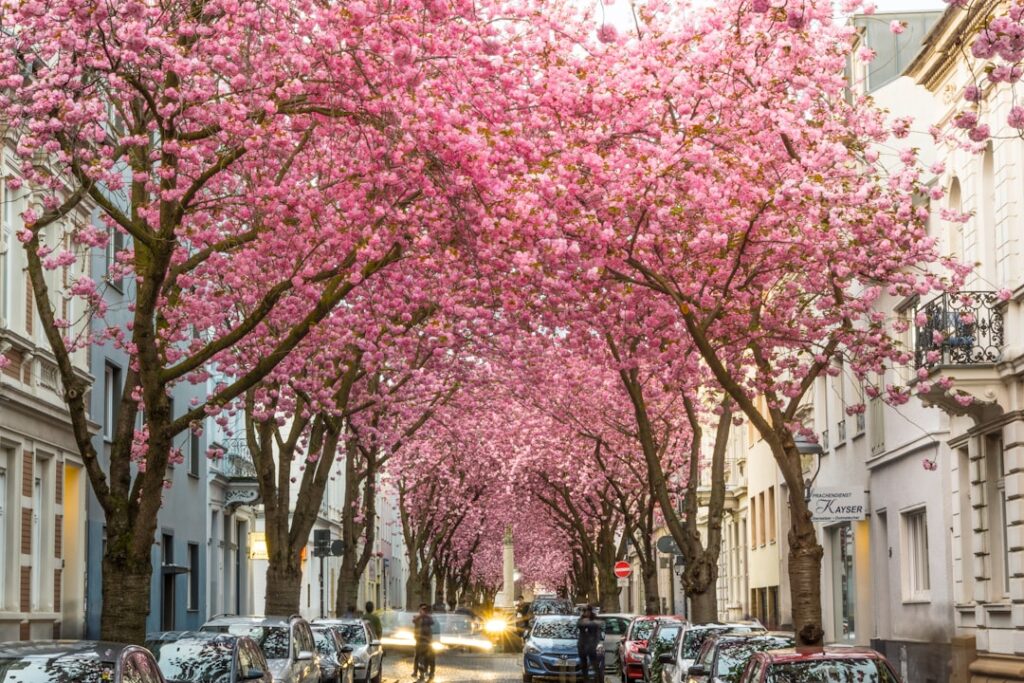
The Bergstraße—the Mountain Road—runs for about 80 kilometers along the western slopes of the Odenwald, connecting Darmstadt in the north to Heidelberg in the south. This isn’t a dramatic Alpine route. Instead, it’s a gentle, sun-soaked strip where the climate is so mild that almond trees bloom in March, vineyards climb terraced hillsides, and locals joke that spring arrives here two weeks before anywhere else in Germany.
The Romans recognized the Bergstraße’s strategic value and climate advantage two thousand years ago, building a road through what they called the strata montana. Today, it’s one of Germany’s most underrated scenic drives, best explored in early spring when the fruit trees are in full blossom and the crowds haven’t yet arrived.
The Blossom Season and What to Expect
Late March through April is when the Bergstraße earns its reputation. Almond trees bloom first, followed by cherry, apple, pear, and plum. The entire route becomes a corridor of white and pink blossoms against the backdrop of forested hills and medieval castle ruins perched above the towns.
The mild climate here is no accident. The Bergstraße sits in the rain shadow of the Odenwald, protected from cold northern winds and warmed by southern exposure. Average temperatures run several degrees higher than the surrounding regions, creating a microclimate that feels more Mediterranean than central German.
If you miss the blossoms, don’t skip the route. Summer brings vineyard hiking, autumn delivers wine festivals and harvest colors, and even winter is mild enough for comfortable walking through the historic town centers.
Towns Worth Stopping For
The Bergstraße threads through a series of small wine towns, each with its own castle ruin and half-timbered Altstadt. Start in Heppenheim, where the Starkenburg castle looms above the town’s medieval market square. The old town is compact and walkable, with a particularly beautiful Rathaus and the Liebigstraße lined with traditional wine taverns.
Bensheim sits just north and serves as the Bergstraße’s unofficial capital. Its Altstadt centers on the Marktplatz, surrounded by timber-frame houses and cafés. Above town, the ruins of Schloss Auerbach offer panoramic views over the Rhine plain. The castle is easily reached by a 30-minute hike through the woods or by car via a winding forest road.
Further south, Weinheim stands out for its two castles—the Windeck ruins on the hill and the intact Schloss Weinheim in town, surrounded by an excellent park with exotic trees. The town also maintains a charming Altstadt with the Marktplatz dominated by the old Rathaus.
Schriesheim is smaller and quieter, known for its Straußwirtschaften—seasonal wine taverns where local vintners serve their own wines with simple food. The Schriesheimer Hof ruin sits above town, accessible via a short but steep trail.
Wine, Food, and the Bergstraße Table
The Bergstraße is Germany’s smallest designated wine region, producing primarily Riesling on the steep, mineral-rich slopes. The wines tend to be lighter and more delicate than their Rheingau or Palatinate cousins, with a distinct freshness.
Most towns along the route host small, family-run wineries. Look for signs reading Winzer or Weingut and don’t hesitate to stop in for a tasting. Many operate seasonal Straußwirtschaften, recognizable by a wreath or broom hung outside the door. These informal wine taverns serve the vintner’s own wines alongside regional dishes—often cold plates of cheese, sausage, and fresh bread.
Local specialties include Handkäs mit Musik, a pungent sour-milk cheese marinated in vinegar and onions, and various asparagus preparations during the spring Spargel season. Bakeries sell Mandelkuchen—almond cakes that celebrate the local almond harvest.
How to Experience the Bergstraße
The route is easily driven in a day, but rushing misses the point. Plan for two or three days to fully explore the towns, hike to the castle ruins, and stop at wineries without watching the clock.
The official Bergstraße route follows the B3 highway, but parallel roads thread through the vineyards and orchards with better views and less traffic. Pick up the free Bergstraße map at any tourist office—it marks scenic detours, hiking trails, and wine estates open for tastings.
By train, the Bergstraße is well-connected. Regional trains run frequently between Heidelberg and Darmstadt, stopping in all the major towns. Weinheim and Bensheim make good bases with regular connections in both directions.
For hikers, the Burgensteig trail runs the length of the Bergstraße, connecting all the major castle ruins through 120 kilometers of forested paths. You can walk the entire route over several days or pick shorter sections between towns.
The Bergstraße rewards travelers who take their time. Subscribe to the Love Germany newsletter for one short story a day about Germany’s lesser-known corners and the traditions that make them worth discovering.
Tours & experiences in Germany


Powered by Viator. Some links are affiliate links — we may earn a small commission at no extra cost to you.