
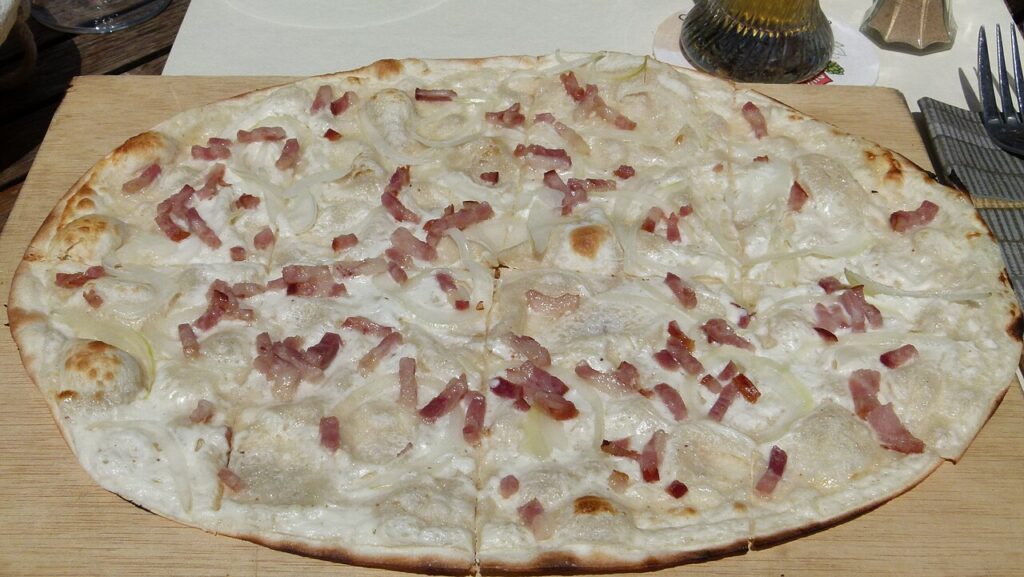

In the wine villages along the Rhine, from Baden-Baden south to Freiburg and west into the Palatinate, you’ll find a flatbread that locals have been baking for centuries. Called Flammkuchen in German and tarte flambée in French, this thin, crispy creation topped with crème fraîche, onions, and bacon is the signature dish of the borderlands—a culinary tradition shared between Germany and Alsace that deserves a place on every traveler’s table.
Unlike pizza, which it superficially resembles, Flammkuchen has a distinctive personality: no tomato sauce, no mozzarella, and a paper-thin crust that shatters when you bite into it. It’s peasant food elevated to an art form, born in the wood-fired ovens of farmhouse bakers who used the dough as a temperature test before sliding in their bread loaves.
The Borderland Origins
Flammkuchen comes from the Rhine Valley region where Germany meets France, particularly Baden and the Palatinate on the German side and Alsace across the border. The name literally means “flame cake,” referring to the practice of baking it in a wood-fired oven at the highest heat, when flames still licked the oven ceiling.
Traditionally, farmers’ wives would roll out a scrap of bread dough into a thin round, spread it with whatever they had on hand—usually thick cream, sliced onions, and bits of bacon or lard—and bake it quickly to test if the oven was hot enough for the day’s bread. What started as a practical gauge became a beloved meal in its own right, especially in autumn and winter when new wine was ready and neighbors gathered to celebrate.
Today, you’ll find Flammkuchen on menus throughout Baden-Württemberg and Rhineland-Palatinate, particularly in wine villages, traditional Straußwirtschaften (seasonal wine taverns), and cozy restaurants with wood-fired ovens. The best versions still honor the original simplicity: a whisper-thin crust, tangy crème fraîche or Schmand, sweet raw onions, and smoky speck or bacon, baked until the edges char and bubble.
Where to Eat Flammkuchen
The Black Forest town of Gengenbach, with its half-timbered marketplace and wine culture, serves excellent Flammkuchen in several traditional restaurants. Head to the Palatinate wine villages along the Deutsche Weinstraße—Deidesheim, Neustadt an der Weinstraße, and Bad Dürkheim—where seasonal wine taverns pair the flatbread with young Riesling and Spätburgunder.
In Baden-Baden and Freiburg, upscale restaurants offer creative variations: wild mushroom and truffle oil, caramelized apple and Munster cheese, or smoked salmon and dill. But purists will tell you that the classic version—what the French call gratinée—remains unbeatable. Some restaurants bring a portable wood-fired oven right to your table, a dramatic touch that fills the dining room with wood smoke and anticipation.
Across the Rhine in Strasbourg and the Alsatian wine route villages of Riquewihr and Eguisheim, you’ll find the same dish under its French name, often served on wooden boards meant for sharing. The experience is nearly identical, a reminder that food culture here transcends borders.
The Art of Making Flammkuchen
The secret to great Flammkuchen lies in three elements: a searingly hot oven (ideally wood-fired), dough rolled thin enough to read through, and restraint with toppings. Too much cream makes it soggy; too many onions overwhelm the delicate balance.
The classic topping ratio is simple: a thin layer of crème fraîche or Schmand (German sour cream) mixed with a touch of quark or fromage blanc, scattered with raw onion rings sliced translucent-thin, and dotted with small pieces of speck or smoked bacon. Salt, white pepper, and sometimes a whisper of nutmeg round out the seasoning. The whole thing bakes in just five to seven minutes at the highest possible heat, emerging with a blistered, crispy crust and toppings that have just begun to caramelize.
Modern variations include vegetarian versions with zucchini and goat cheese, sweet dessert Flammkuchen topped with apple slices and cinnamon, and even breakfast versions with scrambled eggs. But in the wine villages where the tradition runs deepest, most restaurants stick to the original formula, understanding that perfection needs no improvement.
Pairing and Tradition
Flammkuchen is inseparable from wine culture. In Baden and the Palatinate, it’s traditionally paired with young, slightly effervescent white wine called Federweißer (or Neuer Süßer)—the partially fermented grape juice available only in autumn. The sweet, cloudy wine cuts through the richness of the cream and bacon, creating a combination that locals wait for all year.
When Federweißer isn’t in season, choose a crisp Riesling, a fruity Müller-Thurgau, or a light Spätburgunder rosé. The acidity and freshness of these wines balance the flatbread’s richness perfectly. In casual wine taverns, Flammkuchen is often served on wooden boards meant for sharing, making it ideal for groups settling in for an evening of wine tasting and conversation.
Whether you try it in a centuries-old Weinstube in the Palatinate, a modern restaurant in Freiburg, or a rustic Alsatian winstub just across the border, Flammkuchen offers a delicious introduction to the culinary traditions of the Franco-German borderlands—a simple dish that tastes of smoke, community, and the timeless rhythms of vineyard life.
Hungry for more stories from Germany’s regions and tables? Subscribe to the Love Germany newsletter and get one short story a day, delivered fresh to your inbox.
Tours & experiences in Germany


Powered by Viator. Some links are affiliate links — we may earn a small commission at no extra cost to you.