
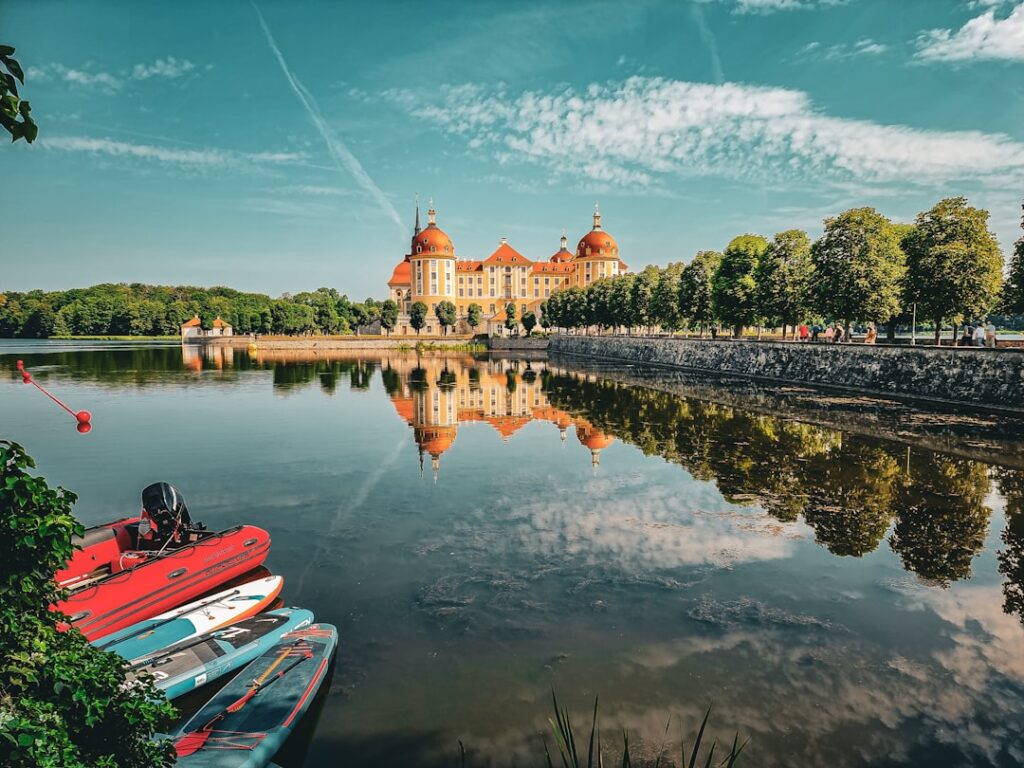
Fifteen kilometers northwest of Dresden, Schloss Moritzburg rises from the center of a large artificial lake like something out of a storybook. This baroque hunting palace, with its four round towers and golden-yellow walls reflected in still water, is one of Saxony’s most photographed landmarks—and instantly recognizable to anyone who’s seen the 1973 fairy tale film Drei Haselnüsse für Aschenbrödel (Three Wishes for Cinderella), which returns to German television every Christmas.
But beyond its cinematic fame, Moritzburg offers a fascinating glimpse into the extravagant world of Saxon court life, where hunting was theater and display mattered as much as sport.
From Renaissance Lodge to Baroque Showpiece
Duke Moritz of Saxony built the original hunting lodge here in 1542–1546, a modest Renaissance structure on what was then dry land. It remained relatively unchanged until Augustus the Strong, Elector of Saxony and King of Poland, decided to transform it between 1723 and 1733 into a grand baroque palace for elaborate hunting parties.
Augustus had the surrounding landscape flooded to create an artificial lake, giving the palace its island setting. Architect Matthäus Daniel Pöppelmann, who also designed Dresden’s Zwinger, oversaw the expansion, adding the distinctive corner towers and transforming the interiors into a showcase of baroque excess. The result was less a hunting lodge than a stage set for courtly spectacle.
Inside, you’ll find the Federzimmer (Feather Room), its walls covered with feathers from more than a million birds, and the Monströsensaal, displaying antlers from deer and elk—including some truly enormous specimens. The collection of Saxon hunting trophies is one of the largest in Europe, and whether you find it impressive or unsettling, it certainly captures the scale of courtly hunting culture.
The Grounds and Fasanenschlösschen
The palace park extends beyond the main building and rewards a longer visit. Walk the shoreline path around the lake for the classic postcard view, especially beautiful in early morning when mist rises from the water, or in late afternoon when the setting sun lights the yellow walls.
About a fifteen-minute walk through the woods brings you to the Fasanenschlösschen (Little Pheasant Castle), a rococo gem built in 1769–1782 for Augustus’s great-grandson. Smaller and more intimate than the main palace, it features chinoiserie interiors and a lighthouse tower—an odd but charming addition to a woodland hunting lodge. The Fasanenschlösschen requires a separate ticket but is well worth the extra euros if you have time.
In winter, the palace hosts a baroque Christmas market on weekends during Advent, with candles, handicrafts, and traditional Saxon treats in the atmospheric courtyard. The palace also opens for special candlelit tours in December.
Practical Information
Moritzburg is easily reached from Dresden by S-Bahn to Radebeul-Ost, then bus 326 directly to the palace (about 45 minutes total). If you’re driving, there’s ample parking near the entrance. The palace is open year-round except for a few weeks in November and January—check ahead if visiting during those months.
Standard tours take about 45 minutes and run in German, though English audio guides are available. If you’re visiting in summer, consider arriving by mid-morning before tour groups; the palace gets busy by midday. Spring and autumn offer the most dramatic light for photography, with fewer crowds than high summer.
Allow at least two hours for the palace and grounds, longer if you plan to visit the Fasanenschlösschen or walk the full circuit of the lake. The small town of Moritzburg has a handful of traditional restaurants and cafés—Churfürstliche Waldschänke, near the palace entrance, serves solid Saxon fare in a historic setting.
Moritzburg pairs beautifully with a day trip from Dresden: visit the palace in the morning, have lunch in town, then return to Dresden for an afternoon exploring the Neustadt district or the Elbe riverside. It’s an easy half-day excursion that feels worlds away from the city.
Want more stories about Germany’s castles, palaces, and hidden corners? Subscribe to the Love Germany newsletter—one short story a day, delivered to your inbox.
Tours & experiences in Germany


Powered by Viator. Some links are affiliate links — we may earn a small commission at no extra cost to you.