
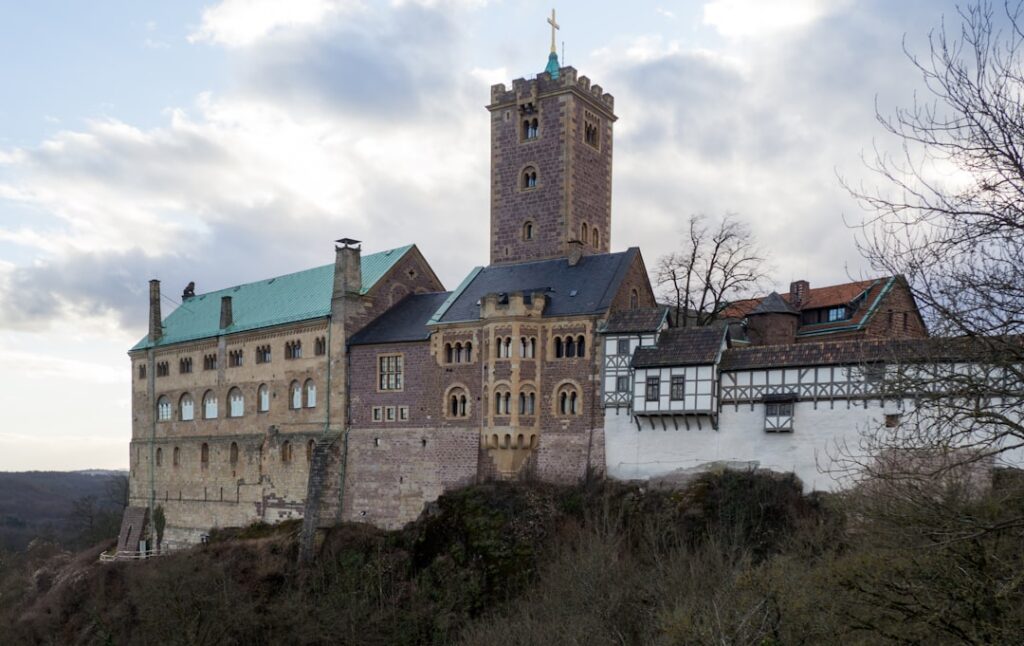
The Wartburg rises from a forested ridge above the small town of Eisenach in Thuringia, its stone walls visible for miles. Founded in 1067, this fortress has witnessed some of the most pivotal moments in German history. But its most famous chapter unfolded in 1521, when Martin Luther took refuge here under the protection of Frederick the Wise and translated the New Testament into German in just eleven weeks.
Unlike many of Germany’s castles, the Wartburg was never conquered, never destroyed, and never sold. It remains one of the best-preserved medieval fortresses in the country, earning its UNESCO World Heritage designation in 1999.
Luther’s Room and the Inkwell Legend
The highlight of any visit is the simple, wood-paneled room where Luther lived and worked from May 1521 to March 1522. Disguised as “Junker Jörg” (Knight George) with a beard and secular clothing, he churned out his revolutionary translation, giving ordinary Germans direct access to scripture for the first time.
You’ll notice a dark stain on the wall. Legend says Luther threw an inkwell at the devil during a moment of spiritual struggle. The stain is almost certainly not original—overeager 19th-century guides may have embellished it—but the story captures the intensity of Luther’s work here. His translation fundamentally shaped the modern German language and fueled the Reformation that split Christianity.
The castle offers guided tours in German, with English audio guides available. Tours run every 15 to 20 minutes and last about 45 minutes. Buy tickets at the visitor center at the base of the hill or online in advance during peak summer months.
The Great Hall and Medieval Splendor
Beyond Luther’s quarters, the Wartburg impresses with its Romanesque architecture. The Festsaal (Great Hall) dates to the early 13th century and hosted the legendary Sängerkrieg, a medieval singing contest among minnesingers that inspired Wagner’s opera Tannhäuser. The hall’s walls are now covered in 19th-century murals depicting medieval life, part of a Romantic-era restoration.
The Elisabeth Gallery honors Saint Elisabeth of Hungary, who lived at the Wartburg from 1211 to 1227. She married Ludwig IV of Thuringia at age 14 and devoted herself to caring for the poor and sick. Widowed at 20, she was canonized just four years after her death. The ornate mosaics depicting her life are stunning examples of 19th-century craftsmanship.
Don’t miss the castle museum, which displays medieval armor, paintings, and Luther-era manuscripts. The view from the South Tower, accessible via a narrow stone staircase, offers sweeping panoramas of the Thuringian Forest.
Getting There and Planning Your Visit
Eisenach sits on the main rail line between Frankfurt and Leipzig, making the Wartburg an easy day trip from either city. From Eisenach’s train station, bus line 10 runs every 30 minutes to the castle parking area, or you can walk the scenic 4-kilometer trail through the forest—it takes about 45 minutes uphill.
The castle is open daily year-round except December 24. Hours are 8:30 a.m. to 5:00 p.m. in summer (April through October) and 9:00 a.m. to 3:30 p.m. in winter. Admission includes the guided tour; expect to pay around €13 for adults.
After your visit, explore Eisenach’s old town. The Luther House, where the reformer lived as a student, is now a museum. Bach fans should visit the house where the composer was born in 1685. Both sites are within walking distance of the train station.
If you’re driving, the Wartburg makes an excellent stop on the route between the Rhine Valley and Dresden, or as part of a Thuringian loop that includes Erfurt and Weimar.
Where History Echoes
Standing in Luther’s small study, looking out the window toward the forest where he walked and wrestled with his doubts, you understand why the Wartburg matters beyond tourism. This is where one man’s convictions changed the trajectory of Western civilization. The words he wrote here reached millions and still shape German culture today.
The castle hosts special events throughout the year, including summer concerts in the Great Hall and Christmas markets in December. Check the official website before you visit for any closures or special programming.
Want more stories about Germany’s castles, towns, and hidden corners? Subscribe to the Love Germany newsletter and get one short story delivered to your inbox every day—the Germany beyond the guidebooks, one email at a time.
Tours & experiences in Germany


Powered by Viator. Some links are affiliate links — we may earn a small commission at no extra cost to you.