
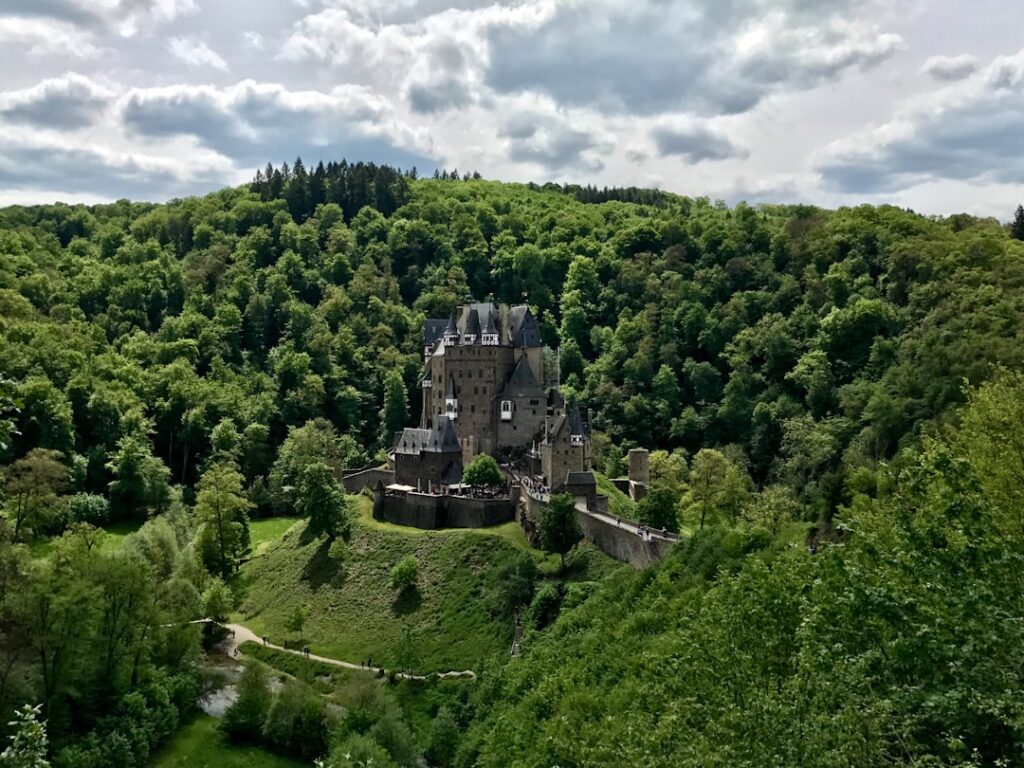
In the forested hills above the Moselle River, one medieval fortress stands as a remarkable exception to centuries of German conflict. While countless castles fell to siege engines, revolutionary armies, and warfare, Burg Eltz survived largely intact—a story rooted in strategic diplomacy, geographic fortune, and one family’s stewardship spanning more than eight centuries.
The castle’s survival began with geography. Nestled in a narrow side valley of the Moselle, concealed by dense woodland, Burg Eltz occupied neither a strategic crossroads nor a commanding height that armies coveted. During the Thirty Years’ War (1618-1648), when Swedish and Imperial forces devastated the Rhineland and reduced neighbouring fortresses to rubble, Burg Eltz’s remoteness proved advantageous. Marauding armies often bypassed it.
But isolation alone cannot explain survival through 33 generations. The Eltz family—whose descendants still own the castle today—practiced a form of political pragmatism rare among German nobility. Rather than allying rigidly with emperor or elector, they cultivated relationships across confessional and political divides. When French Revolutionary armies swept through the Rhineland in the 1790s, seizing and demolishing feudal strongholds as symbols of aristocratic oppression, Burg Eltz was spared.
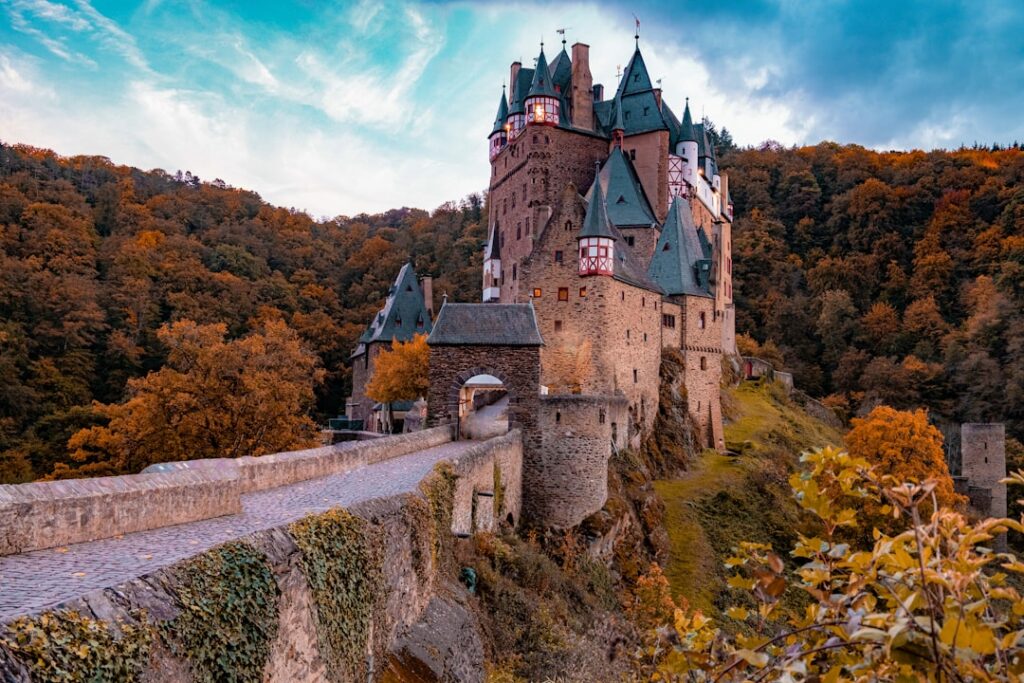
The castle faced challenges during the 19th century, when Prussian expansion and the Wars of German Unification saw systematic destruction of Rhineland fortifications. Between 1866 and 1871, military engineers dismantled dozens of castles deemed obsolete or potentially hostile. Yet Burg Eltz escaped this fate. By then, the Romantic movement had transformed medieval ruins into objects of cultural veneration. Writers—including Victor Hugo, who visited the castle during his Rhine journey—championed its preservation. The Eltz family, astutely recognizing this shift, positioned their ancestral home as a cultural treasure.
The castle’s architecture tells the story of continuous habitation. First documented in 1157, Burg Eltz retains medieval fabric including Gothic additions from the 14th century and Renaissance living quarters. The armoury holds weapons spanning centuries, while the treasury houses gold and enamel work. Each generation added rather than replaced, creating a chronicle of German domestic life from the Middle Ages to modernity.
The 20th century brought severe challenges. On September 20, 1920, a catastrophic fire destroyed parts of the Kempenich Houses as well as the roofs of Rodendorf and Platteltz. The family undertook a careful reconstruction that continued into the mid-1930s, restoring the structures using historical records and remaining original elements. World War II brought additional threats as Allied bombers targeted Moselle crossings and the surrounding forests saw fierce combat in late 1944, yet the castle survived this period as well.
Today, Burg Eltz stands as one of Germany’s most complete medieval castles, a testament to survival through adaptation and careful restoration. While other fortresses became ruins, museums, or hotels, it remains what it has long been: a family home spanning nearly a millennium. For visitors descending the forest path to glimpse its clustered towers rising from the gorge, the castle offers an increasingly rare connection to medieval Germany, preserved through centuries of continuous care and dedicated restoration.
Tours & experiences in Germany


Powered by Viator. Some links are affiliate links — we may earn a small commission at no extra cost to you.