
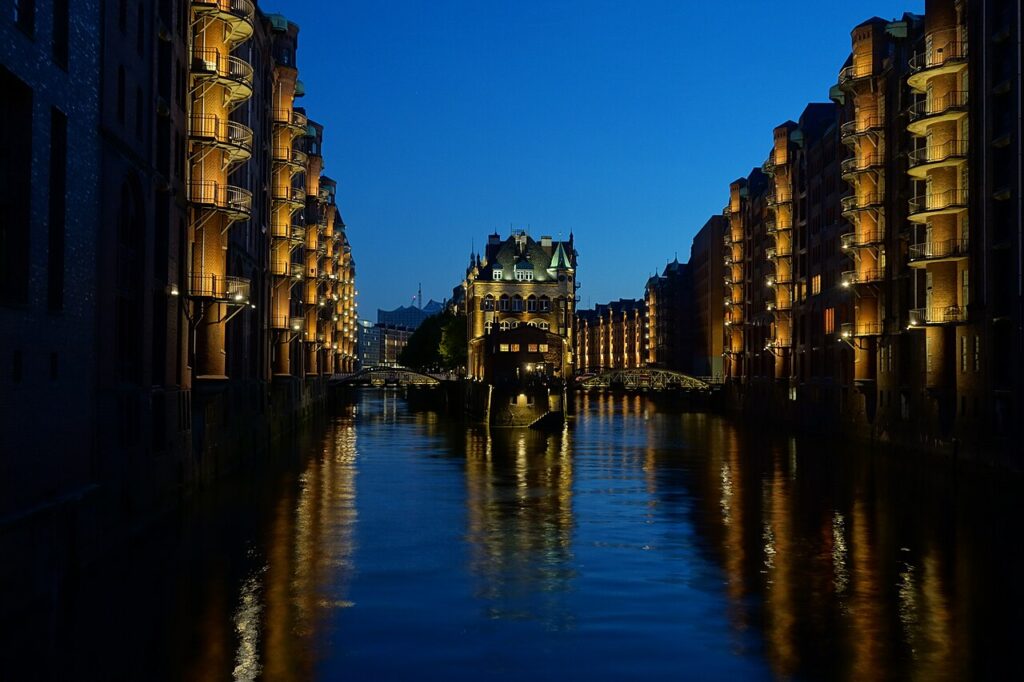
Hamburg’s Speicherstadt rises from the Elbe’s tidal canals like a city within a city—seven stories of red brick warehouses stretching across 26 hectares of water and narrow islands. Built between 1883 and 1927, this is the world’s largest warehouse district constructed entirely on oak timber piles, and since 2015, it’s been a UNESCO World Heritage Site. The neighborhood still smells faintly of coffee, tea, and spices from the goods once stored behind those Gothic Revival facades.
The district sits between the Elbe and the city center, connected by a network of cast-iron bridges spanning the Fleets—the narrow canals that allowed barges to load and unload directly at warehouse doors. Today, those same waterways make Speicherstadt one of Germany’s most photogenic quarters, especially at dusk when the brick glows amber and the bridges light up over dark water.
The Working Warehouses
Speicherstadt wasn’t built for tourists. When Hamburg became part of the German Customs Union in 1888, it needed a free port zone where goods could be stored duty-free. Architects tore down the Gängeviertel—a crowded residential district—and built this fortress of commerce instead. The warehouses stored everything from tobacco to silk, but especially Oriental rugs, which still occupy climate-controlled spaces in several buildings.
Block L, near Kannengießerort bridge, remains an active warehouse where Persian and Turkish carpets are rolled out for inspection by dealers. You can smell the wool. In Block R, along Auf dem Sande, the Speicher Coffee Roastery continues the district’s coffee tradition—beans arrive green and leave roasted, just as they did a century ago.
The architecture is practical but beautiful: neo-Gothic gables, ornamental turrets, and green copper roofs. The buildings are narrow—just deep enough for winches to haul sacks from canal to attic. Look up and you’ll still see the hoist beams jutting from the gables.
Museums in the Warehouses
Several blocks have traded goods for galleries. The Miniatur Wunderland, in Block D at Kehrwieder 2, is the world’s largest model railway—a sprawling landscape of tiny trains, ships, and airports that draws half a million visitors annually. Book ahead; it’s genuinely popular.
Across St. Annenufer, the Speicherstadt Museum in Block L shows how the warehouses functioned: winches, scales, sample rooms, and the lives of the Quartiersleute—the warehousemen who worked these spaces. It’s small but specific, the kind of museum that makes you understand a place rather than just photograph it.
The Hamburg Dungeon, also in Block D, offers theatrical horror based on the city’s plague, pirate, and fire history. It’s aimed at families and leans into jump scares, but the actors commit fully to their roles. The Dialogue in the Dark exhibition, in the same building, invites visitors into pitch-black rooms to experience daily tasks without sight—an unexpectedly moving hour led by blind guides.
Walking the District
Start at Baumwall U-Bahn station and cross Kibbelstegbrücke bridge for the classic postcard view: the longest row of warehouses reflected in Zollkanal. Walk east along Auf dem Sande, the main canal-side street, past Block R and S. Detour onto Kannengießerortbrücke for a quieter perspective, then loop back via Holländischer Brook.
The best light is early morning or late afternoon. In summer, the canals fill with kayakers and small tour boats. In winter, fog rolls in from the Elbe and the brick disappears into mist—moody and cinematic.
For a guided overview, the Hamburg Hop-on Hop-off Sightseeing Tour on Red Double Decker Bus includes Speicherstadt and connects it with the nearby HafenCity waterfront development. The route gives you context: where the old port ends and the new city begins.
Coffee, Cake, and Canals
Stop at Fleetschlösschen, a small café in a former lockkeeper’s house at Brooktorkai, for coffee and a slice of Rote Grütze—North German red berry pudding with cream. The terrace overlooks Holländischer Brook and catches the afternoon sun.
If you want something more substantial, head to the northern edge of Speicherstadt into HafenCity. The restaurants along Magellan-Terrassen serve fresh fish from the Fischmarkt, and you can watch container ships glide past on the Elbe.
Speicherstadt rewards slow walking. It’s not large, but the bridges and canals create a maze of perspectives. You can cover the length in twenty minutes or spend half a day tracing water, brick, and shadow.
Want more stories from Germany’s hidden corners? Subscribe to the Love Germany newsletter and get one short story a day—cities, castles, food, and the roads less traveled.
Heads up — some links in this article are affiliate links. If you sign up through them, we may earn a small commission at no extra cost to you. We only recommend tools we use ourselves.
Tours & experiences in Germany


Powered by Viator. Some links are affiliate links — we may earn a small commission at no extra cost to you.