
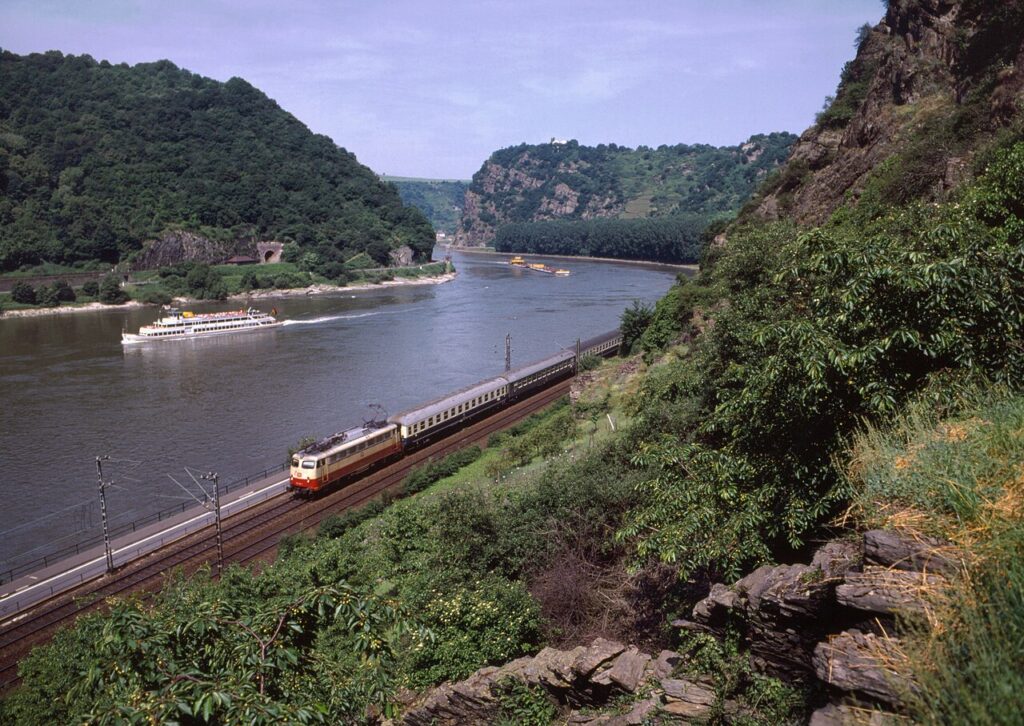
Rising 433 feet above the narrowest point of the Rhine, the Loreley rock has captivated travelers for centuries. This slate cliff near St. Goarshausen marks the most dangerous section of the river, where strong currents and hidden reefs once claimed dozens of ships. Today it’s the symbolic heart of the Rhine Gorge, a UNESCO World Heritage landscape where legend, nature, and river culture converge in one dramatic view.
The rock takes its name from a siren in German folklore who sat atop the cliff, combing her golden hair and singing sailors to their doom. Heinrich Heine immortalized the tale in his 1824 poem “Die Lorelei,” and the legend has been inseparable from this stretch of river ever since. Whether you believe in river sprites or not, the view from the top makes the visit worthwhile.
The Viewing Platform and Visitor Center
The modern Loreley Visitor Center sits on the plateau above the cliff, accessible by car or a steep footpath from St. Goarshausen. The center includes exhibits on Rhine geology, shipping history, and the evolution of the Loreley legend through art and literature. But the real draw is the viewing platform, which offers a sweeping panorama of the Rhine as it bends around the rock, with vineyards rising on both banks and castle ruins punctuating the ridgelines.
On clear days you can watch cargo barges navigate the tricky current below, their captains radiating traffic updates to approaching vessels. The Rhine at this point is only 370 feet wide—narrow enough that echo effects once made communication between riverbanks possible, adding to the cliff’s mystical reputation.
The plateau also hosts an open-air stage where summer concerts and festivals take place, including the annual “Rhine in Flames” fireworks display. Arrive early on event nights, as parking fills quickly.
Hiking the Rheinsteig Trail
The Rheinsteig long-distance trail passes directly over the Loreley, making it a natural stopping point for hikers tackling the Rhine Gorge on foot. The section from St. Goar (across the river via ferry) to St. Goarshausen via the Loreley plateau covers about seven miles and takes four to five hours, with significant elevation gain and vineyard paths that can be slippery after rain.
For a shorter walk, start in St. Goarshausen and follow the marked trail up through the forest to the plateau—about 45 minutes of steady climbing. The path emerges near the visitor center, where you can rest before heading back down or continuing north toward Kamp-Bornhofen.
Wear sturdy shoes. The slate trails can be loose and uneven, especially on descents.
Getting There and Where to Stay
St. Goarshausen sits on the Rhine’s right bank, directly below the Loreley. It’s connected by regional train to Koblenz (30 minutes south) and Wiesbaden (one hour north). From the train station, it’s a 20-minute walk to the base of the footpath, or you can drive up the winding road to the visitor center parking lot.
If you’re approaching from the left bank, take the ferry from St. Goar, which runs every 15 to 20 minutes and accommodates cars. St. Goar offers more hotel options and sits below the ruins of Burg Rheinfels, one of the largest castle complexes on the Rhine.
For lodging, consider the riverside hotels in either St. Goar or St. Goarshausen, where rooms with Rhine views let you watch river traffic from your window. Boppard and Bacharach, both within a 20-minute train ride, offer additional accommodations and make good bases for exploring the entire Rhine Gorge.
Combine with Rhine Gorge Highlights
The Loreley sits at the center of the Rhine’s most scenic stretch, making it easy to combine with other highlights. South toward Bacharach, you’ll find Burg Stahleck and Pfalzgrafenstein, the toll castle built on an island in midriver. North toward Boppard, the Rhine bends through the “Great Rhine Bend,” best seen from the Vierseenblick viewpoint above town.
River cruises from Koblenz or Rüdesheim pass the Loreley, with most boats sounding their horns as they navigate the narrows—a tradition that echoes the echo effects that once defined this stretch. The KD Line offers hop-on, hop-off service between major towns, letting you disembark for a few hours before catching the next boat upriver or down.
Spring and early fall bring the best light for photography, with fewer crowds than summer and the vineyards turning color in October. Winter visits are atmospheric but cold, with fewer services open at the visitor center.
The Loreley distills everything that makes the Rhine Gorge compelling: dramatic topography, layers of history, and a landscape shaped by centuries of river trade and wine culture. It’s a view that rewards the climb.
Want more stories like this from Germany? Subscribe to the Love Germany newsletter and get one short story a day, straight to your inbox.
Tours & experiences in Germany


Powered by Viator. Some links are affiliate links — we may earn a small commission at no extra cost to you.