
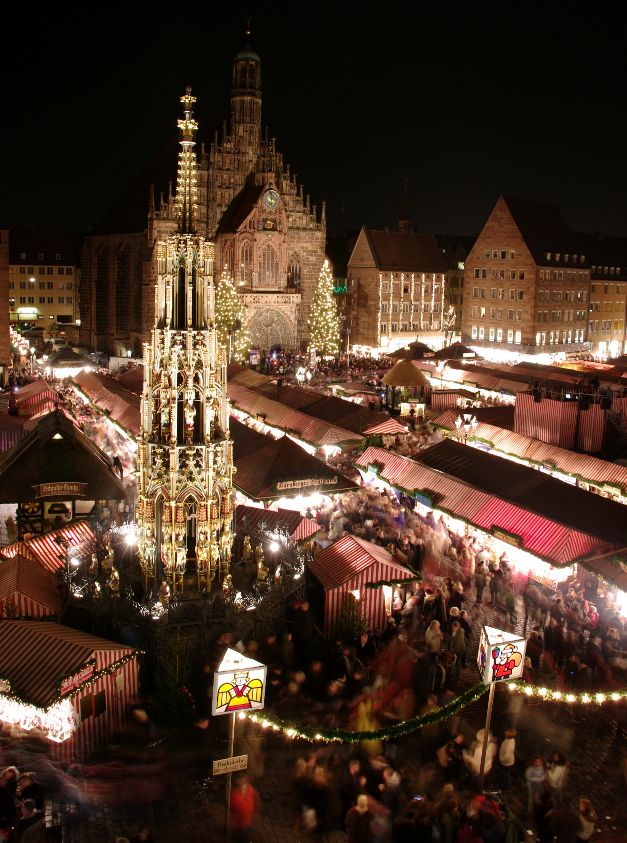
Every year from late November through Christmas Eve, Nuremberg’s Hauptmarkt transforms into the Christkindlesmarkt, Germany’s most celebrated Christmas market. With its red-and-white striped stalls, spiced Glühwein, and the scent of roasted almonds drifting through medieval lanes, this is the market that sets the standard for all others.
First documented in the mid-16th century, the Christkindlesmarkt draws roughly two million visitors each season. But beyond the crowds and the Instagram moments, there’s a rhythm and tradition here that rewards those who know where to look.
The Christkind and Opening Ceremony
The market opens on the Friday before the first Advent with a ceremony led by the Christkind, a golden-haired angel figure chosen every two years from local young women. From the balcony of the Church of Our Lady (Frauenkirche), the Christkind delivers a prologue welcoming visitors to the market. It’s a theatrical moment, and locals take it seriously.
The Christkind appears throughout the season at hospitals, care homes, and children’s events. If you’re visiting during opening weekend, arrive early—the Hauptmarkt fills quickly, and the ceremony draws standing-room-only crowds.
What to Eat and Drink
Nuremberg’s Christmas market food goes beyond the usual bratwurst. Start with Nürnberger Lebkuchen, the city’s famous gingerbread, sold in tins and fresh from market stalls. The Schmidt family has been baking it here since 1926, and their stand near the Schöner Brunnen fountain is worth seeking out.
For something warming, try Feuerzangenbowle, a theatrical punch made by suspending a rum-soaked sugarloaf over mulled wine and setting it alight. The flaming sugar caramelizes and drips into the spiced wine below. You’ll find it at several stands, but the one near Obstmarkt does it best.
The classic Christkindlesmarkt bratwurst is the Drei im Weggla—three small Nürnberger Rostbratwurst tucked into a crusty roll with mustard. These finger-sized sausages are a Nuremberg institution, protected by EU law to ensure they’re made within city limits. Grab them from Bratwursthäusle’s market stand if the line isn’t too long.
The Stalls You Shouldn’t Miss
The market is divided into roughly 180 stalls, and not all are created equal. The Kinderweihnacht section, designed for children, offers a gentler pace with carousels, a small railway, and storytelling sessions in the Hans-Sachs-Platz.
For handcrafted ornaments, visit the stalls clustered near the Frauenkirche. Look for Zwetschgenmännle, traditional figures made from prunes and other dried fruit, dressed in intricate costumes. These date back centuries and make far better souvenirs than mass-produced trinkets.
The market also hosts the Sternenhaus, a towering Advent calendar where a window opens each evening at 5:30 p.m. to reveal a Christmas scene. It’s a small tradition, but one that draws a faithful crowd of locals and their children.
When to Visit
The Christkindlesmarkt runs from late November through December 24, closing at 2 p.m. on Christmas Eve. Weekdays, especially mornings, offer a calmer experience. Friday and Saturday evenings are atmospheric but packed.
If you’re combining the market with sightseeing, Nuremberg’s Old Town is compact and walkable. The Imperial Castle (Kaiserburg) sits above the market, and the views from its ramparts over the red-roofed city and illuminated stalls are worth the climb. The Germanic National Museum, Germany’s largest cultural history museum, is a ten-minute walk and stays open late on Thursdays.
Nuremberg is well connected by train, with direct ICE services from Munich (one hour), Frankfurt (two hours), and Berlin (three hours). The Hauptbahnhof is a fifteen-minute walk from the Hauptmarkt, or you can take the U-Bahn to Lorenzkirche.
Practical Tips
Bring cash—many stalls don’t take cards. The Glühwein mugs require a deposit (Pfand), usually €3 to €5, refunded when you return the mug. Some visitors keep them as souvenirs; each year’s mug has a unique design.
Dress warmly. December temperatures in Nuremberg hover around freezing, and the market is entirely outdoors. Layering and good boots make all the difference.
If the Hauptmarkt feels overwhelming, duck into the side streets. The Handwerkerhof, a small courtyard near the train station designed to resemble a medieval village, hosts artisan workshops and its own quieter Christmas market.
Want more stories from Germany’s cities, regions, and traditions? Subscribe to the Love Germany newsletter and get one short story a day, straight to your inbox.
Tours & experiences in Germany


Powered by Viator. Some links are affiliate links — we may earn a small commission at no extra cost to you.