
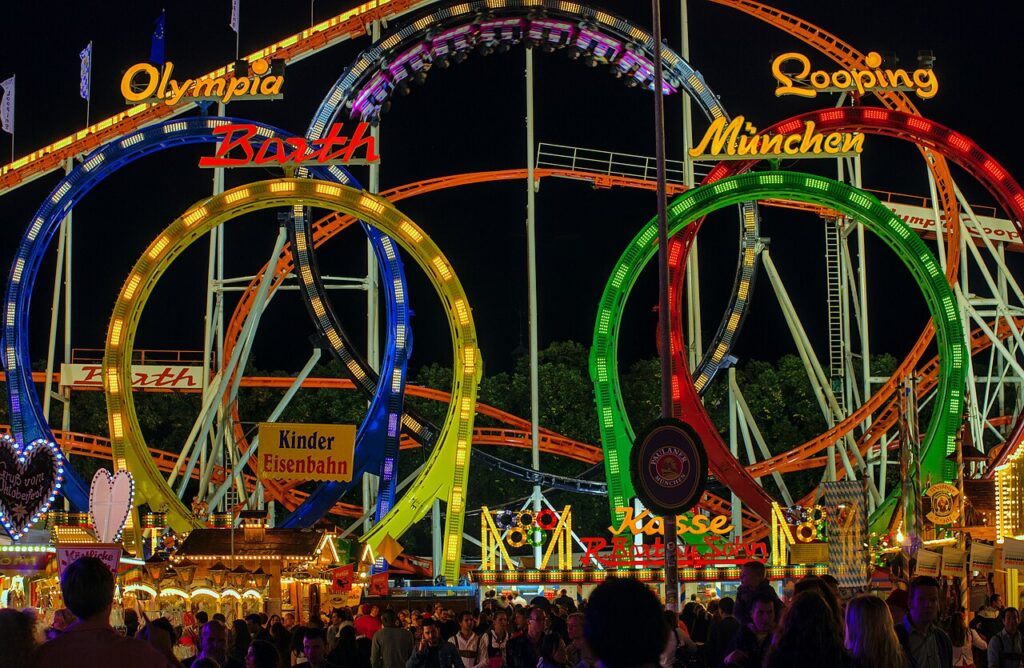
Munich’s Oktoberfest is the world’s most famous beer festival, but it’s far from the only one. Across Bavaria and throughout Germany, towns and cities host their own Volksfeste—folk festivals with beer tents, traditional music, rides, and roasted almonds—that offer all the atmosphere of Munich with a fraction of the crowds and a stronger sense of local tradition.
If you want lederhosen, brass bands, and liter steins but prefer a festival where locals outnumber tourists, these regional celebrations deliver authentic Bavarian and German festival culture without the chaos.
Stuttgart’s Cannstatter Volksfest: Bavaria’s Swabian Rival
Held annually from late September through mid-October, the Cannstatter Volksfest in Stuttgart is Germany’s second-largest beer festival after Munich, yet it remains relatively unknown to international visitors. Locals affectionately call it the Wasen, after the riverside meadow where it takes place.
The festival dates back to 1818, when King Wilhelm I of Württemberg established it as an agricultural fair following years of famine. Today it blends tradition with modernity: you’ll find enormous beer tents pouring local Swabian brews, a parade featuring decorated horse-drawn beer wagons, and a fruit column crowned with 30,000 apples, pears, and plums as a nod to the festival’s agricultural roots.
What sets the Wasen apart is its Swabian character. The beer tents serve regional specialties like Maultaschen and Gaisburger Marsch alongside the usual roast chicken and pork knuckle. The crowd is largely local, the vibe more relaxed than Munich’s increasingly international scene. Plus, Stuttgart’s location makes it an easy day trip from the Black Forest or Heidelberg.
Gäubodenvolksfest in Straubing: Bavaria’s Hidden Giant
Every August, the small city of Straubing in Lower Bavaria hosts the Gäubodenvolksfest, drawing over a million visitors to what locals proudly call the “fifth season.” It’s Bavaria’s second-largest festival after Oktoberfest, yet most travelers have never heard of it.
The festival runs for ten days in mid-August and captures old Bavaria at its most authentic. Six large beer tents serve local brews from the region’s smaller breweries, and the fairground sprawls with traditional rides, shooting galleries, and stalls selling roasted almonds and Lebkuchenherzen (gingerbread hearts). The opening day parade features more than 4,000 participants in traditional costume, oxen-drawn wagons, and marching bands.
Straubing itself is worth exploring: a well-preserved medieval town with a long market square, Gothic churches, and the excellent Gäubodenmuseum, home to a spectacular Roman treasure hoard. Stay overnight and you’ll experience the festival as locals do—without the rush to catch the last train back to Munich.
Bergkirchweih in Erlangen: The Franconian Beer Cellar Festival
Franconians will tell you they don’t need Munich. They have the Bergkirchweih, or simply the Berg, a twelve-day festival held every late May and early June in the university town of Erlangen, just north of Nuremberg.
What makes the Berg unique is its location: the festival takes place on a hillside honeycombed with centuries-old beer cellars carved into the sandstone. Local breweries built these cellars to store beer before refrigeration, planting chestnut trees above them for shade. Today, those cellars are tapped each spring and the trees provide natural canopy for 11,000 seats spread across a dozen beer gardens and tents.
The atmosphere is more rustic and less formal than Munich’s Oktoberfest. You’ll sit at long wooden tables under the trees, order directly from servers carrying trays of Erlangen’s distinctive amber lagers, and watch students, families, and retirees mingle in the dappled light. The Berg is walkable from Erlangen’s compact old town, and the city’s location makes it an easy add-on to a Nuremberg or Bamberg itinerary.
Practical Tips for Regional Volksfeste
Most regional festivals run for one to two weeks and follow a similar rhythm. Weekday afternoons and evenings are calmer and easier to navigate; weekends draw the biggest crowds. Reservations in beer tents are rarely required outside Munich, but arriving before 6 p.m. on Fridays and Saturdays is wise.
Traditional dress is common but not mandatory. Locals wear Dirndl and Lederhosen with pride, and visitors are welcome to join in—just make sure your outfit is respectful and well-fitted. Cheap costume versions stand out.
Each festival has its own beer tradition. In Stuttgart, you’ll drink Swabian lagers from breweries like Dinkelacker and Schwaben Bräu. In Straubing, it’s Lower Bavarian brews. In Erlangen, the local specialties are copper-toned Kellerbier and Zoigl. A Maß (liter) typically costs between €10 and €13, slightly less than Munich.
Most of these festivals are easily accessible by train. Stuttgart and Erlangen have excellent connections to Germany’s rail network. Straubing requires a regional train from Regensburg or Munich, but the journey through the Bavarian countryside is half the charm.
If you’re planning a trip that takes you beyond the obvious stops, regional Volksfeste offer a window into local life that few tourists experience. The beer is just as cold, the music just as loud, and the sense of tradition even stronger.
Want more stories like this delivered to your inbox? Subscribe to the Love Germany newsletter and get one short story a day about the Germany you won’t find in the guidebooks.
Tours & experiences in Germany


Powered by Viator. Some links are affiliate links — we may earn a small commission at no extra cost to you.