
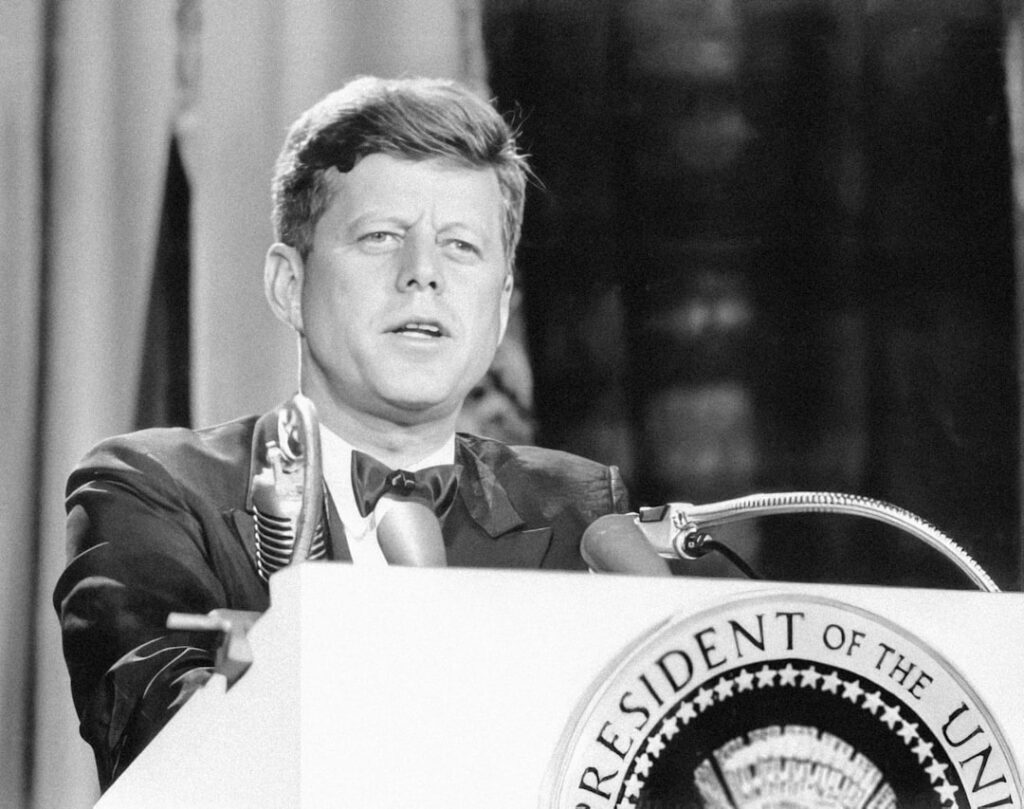
On June 26, 1963, one of the most famous speeches in Cold War history echoed across the divided city of Berlin. President John F. Kennedy stood before the Rathaus Schöneberg and declared his solidarity with the people of West Berlin in words that would resonate for generations: “Ich bin ein Berliner.” What many remember about that historic moment is the power of Kennedy’s words. What fewer recall is that the man delivering them was deeply, proudly Irish-American—and that his connection to Ireland shaped his worldview in profound ways.
Kennedy’s great-grandfather Patrick Kennedy left County Wexford during Ireland’s Great Famine in October 1848, sailing to Boston to escape starvation and build a new life. Four generations later, his descendant would become the first Irish Catholic president of the United States, carrying with him a sense of identity forged by emigration, struggle, and the determination to overcome prejudice.
The Berlin visit came just five months before Kennedy’s assassination and represented a pivotal moment in US-German relations. Standing in the shadow of the Berlin Wall, erected less than two years earlier, Kennedy addressed a crowd estimated at over 120,000 Berliners. His speech was a masterclass in moral clarity, defending freedom and democracy at a moment when both seemed under existential threat. “All free men, wherever they may live, are citizens of Berlin,” he proclaimed, “and therefore, as a free man, I take pride in the words ‘Ich bin ein Berliner.'”
The famous phrase has been the subject of linguistic debate for decades—some claiming it inadvertently translated to “I am a jelly doughnut” because of the article “ein.” In reality, Kennedy’s German was grammatically correct and perfectly understood by his audience, who erupted in thunderous applause. The myth persists, but Berliners themselves have never doubted what their American visitor meant that day.
From Berlin to Ireland
Kennedy’s Irish heritage wasn’t merely genealogical trivia—it was central to his political identity. Following his Berlin speech, Kennedy traveled to Ireland, arriving on the evening of June 26, 1963. The next day, he made an emotional visit to his ancestral home in Dunganstown, County Wexford. He was greeted as a returning son, and the visit clearly moved him deeply. He spoke of Ireland’s history of emigration and its contribution to American life, themes that connected directly to his own family story.
This Irish-American perspective gave Kennedy a particular understanding of displacement, division, and the yearning for freedom—themes that resonated powerfully in Cold War Berlin. The Irish experience of British rule, the struggle for independence, and the subsequent partition of the island gave Kennedy a framework for understanding Berlin’s division. Like Ireland, Berlin was a place where history, politics, and identity collided.
The connection between Ireland and Germany through Kennedy is part of a larger pattern. Many US Presidents with Irish Heritage have played significant roles in shaping German-American relations, from Ronald Reagan (whose Irish ancestors came from County Tipperary) to Joe Biden (with roots in Counties Louth and Mayo). These Irish-American leaders brought to their diplomacy an understanding of Europe shaped by their ancestral connections.
Today, the Rathaus Schöneberg preserves the memory of Kennedy’s visit, and a plaque marks the spot where he spoke. In Ireland, Kennedy is remembered with equal reverence—a bridge between two places, two histories, and two struggles for freedom. His words in Berlin that summer day in 1963 weren’t just American rhetoric; they were the voice of an Irish-American president standing with a divided city, speaking the universal language of liberty that his ancestors had sought when they left Wexford more than a century before.
Tours & experiences in Germany


Powered by Viator. Some links are affiliate links — we may earn a small commission at no extra cost to you.