
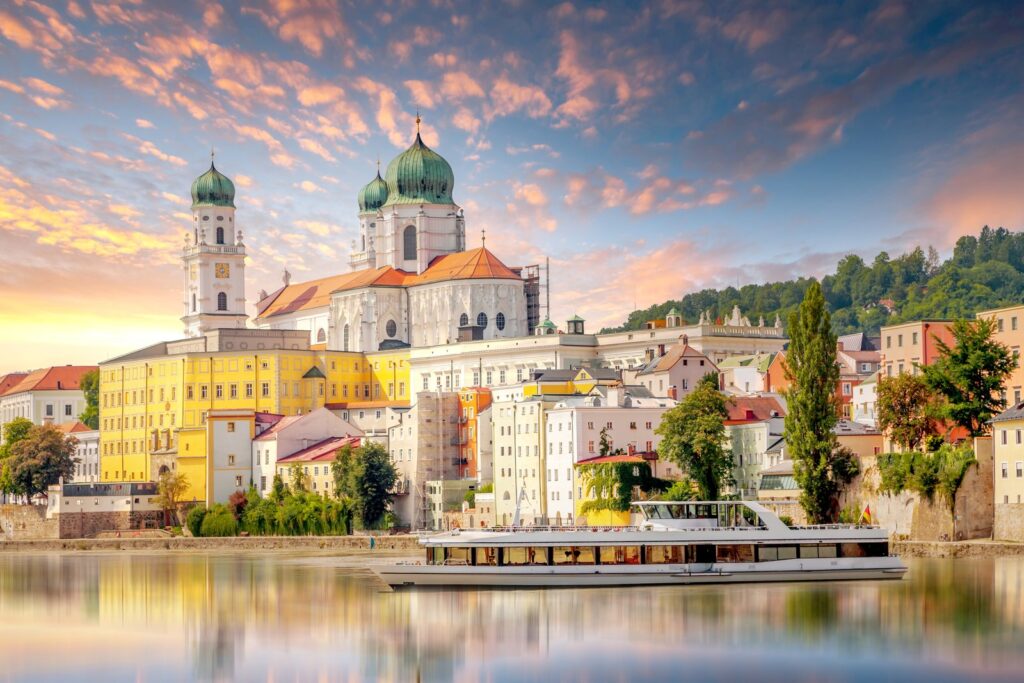
Passau sits at one of Europe’s most dramatic confluences. The Danube flows in from the west, the Inn descends from the Alps to the south, and the smaller Ilz emerges from the Bavarian Forest to the north. All three meet here, and the city spreads across the wedges of land between them, its skyline dominated by the green domes of St. Stephen’s Cathedral.
The old town occupies the narrow peninsula between the Danube and the Inn, its streets rising steeply from both riverbanks. To the east, Austria begins just a few kilometers downstream. To the south, the Inn forms the border. Stand at the confluence and you can see three countries from one spot: Germany, Austria, and, on clear days, the Czech hills to the north.
St. Stephen’s Cathedral and the World’s Largest Church Organ
St. Stephen’s Cathedral anchors the old town from its highest point. Rebuilt in the 17th century after a fire, it’s a baroque interior wrapped around Gothic bones. The vaulted ceiling is covered in stucco and frescoes, and the organ—17,974 pipes across five separate instruments—holds the title of largest church organ in the world. Daily organ concerts at noon let you hear it in full voice, and the acoustics are worth the trip alone.
The cathedral square, Domplatz, opens out in front with views south toward the Inn and the Austrian hills beyond. From here, Residenzplatz slopes down toward the rivers, lined with pastel townhouses and cafés.
The Altstadt: Narrow Streets Between Two Rivers
The old town is a sliver of land, never more than a few blocks wide. Streets run parallel to the rivers or climb the ridge in between. Pedestrian lanes like Höllgasse and Schustergasse are lined with Gothic arches, wrought-iron signs, and small shops selling glass, pottery, and local spirits.
At the tip of the peninsula, the Veste Oberhaus fortress overlooks the city from the north bank of the Danube. Built in 1219, it served as the residence of Passau’s prince-bishops for centuries. Today it houses a regional museum with exhibits on the city’s history, trade along the Danube, and the role of the river as a frontier. The view from the ramparts takes in the entire confluence and the rooftops below.
You can reach the fortress on foot via a steep trail from the old town, or by shuttle bus in summer. The walk down through the forest and back into the city is easier on the knees and brings you past small gardens and overlook points.
Three Rivers, Three Colors
The confluence itself is visible from several vantage points. The easiest is the promenade along the Inn, where you can watch the blue-green water of the Alpine river meet the muddy brown of the Danube. The two don’t mix immediately; the line between them holds for several hundred meters downstream.
The Ilz, flowing in from the Bavarian Forest, adds a third color—dark, almost black, stained by peat. The effect is subtle but visible from the right angle, especially in spring when snowmelt makes the Inn run fast and pale.
River cruises leave from the docks near Rathausplatz, many heading east into Austria or west along the Danube Gorge. Shorter sightseeing loops circle the old town and pass under the bridges connecting the three banks.
Getting There and When to Visit
Passau is two hours by train from Munich, with direct regional connections throughout the day. The station sits on the south bank of the Danube, a ten-minute walk from the old town. If you’re driving, parking is limited in the center; use the garage near the Nibelungenhalle or park across the river and walk in.
Spring and fall bring the best light and fewer cruise passengers. Summer is busy, especially when multiple river ships dock at once. Winter is quiet, and the Christmas market fills Domplatz and Residenzplatz with stalls selling candles, ornaments, and mulled wine.
Flooding is part of life here. High-water marks on buildings throughout the old town record the Danube’s reach in past centuries, some reaching the second floor. Modern defenses and early-warning systems mean the city manages the risk, but if you visit in late winter or early spring, check forecasts.
Where to Eat and Drink
Passau’s restaurants lean toward Bavarian standards with an Austrian accent. Schweinshaxe, dumplings, and river fish appear on most menus. Heilig-Geist-Stift-Schenke, inside a 14th-century hospital building, serves roast pork and local beer in vaulted dining rooms overlooking the Danube. Café Pechlaner, near the town hall, has been baking cakes and pastries since the 19th century; the apple strudel and Sachertorte are both excellent.
For a drink with a view, the terrace at Veste Oberhaus looks down over the rivers and rooftops. In the old town, small wine bars along Höllgasse pour Austrian and Bavarian whites alongside local schnapps.
Passau rewards a full day or an overnight stay. The city is compact enough to see on foot, but the light changes on the rivers throughout the day, and the evening quiet after the day-trippers leave is worth staying for. If you want one story a day about Germany—its towns, landscapes, food, and traditions—subscribe to the Love Germany newsletter.
Tours & experiences in Germany


Powered by Viator. Some links are affiliate links — we may earn a small commission at no extra cost to you.