
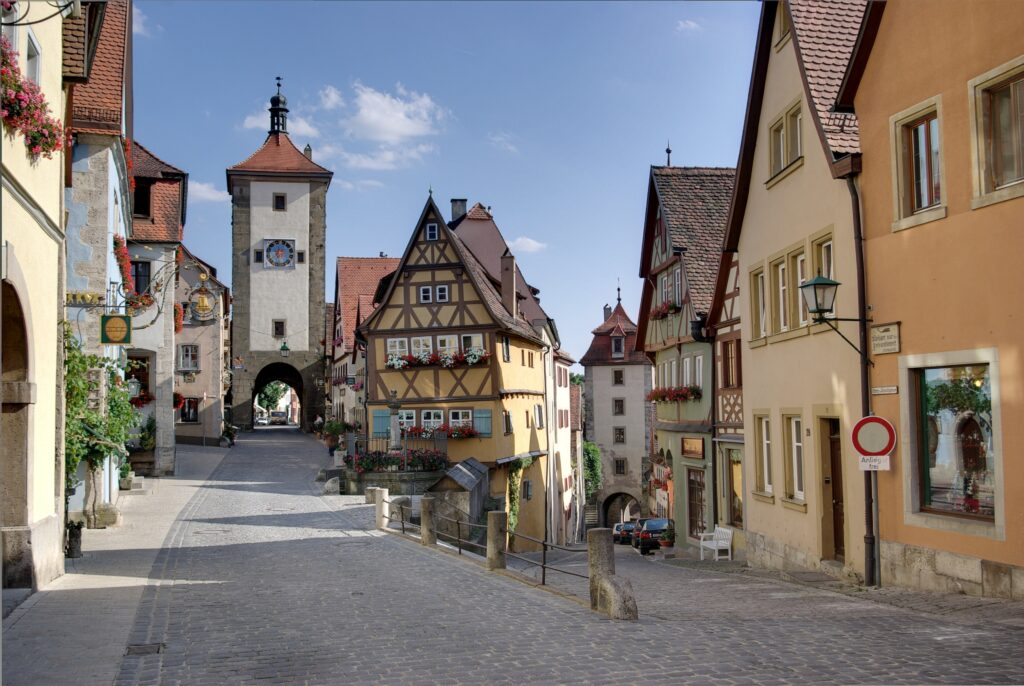
Rothenburg ob der Tauber sits on a plateau above the Tauber River in Franconia, its medieval walls encircling a town that looks much as it did five centuries ago. While it’s one of Germany’s most visited small towns—and a highlight of the Romantic Road—Rothenburg rewards those who venture beyond the main square and stay past the tour bus departures.
The town’s survival is partly lucky accident: too poor to modernize in the 19th century, it preserved what wealthier cities tore down. Today, that accident of history draws visitors from around the world to walk ramparts, explore towers, and wander lanes where every corner looks like a film set.
Walking the Town Walls
Rothenburg’s medieval fortifications remain almost completely intact, and you can walk the covered wooden walkway that runs along the top for roughly two and a half miles. Access points are scattered around town, but a good place to start is near the Rödertor tower on the eastern side.
The walk offers rooftop views over the old town’s sea of red tiles, and you’ll pass defensive towers, gates, and bastions along the way. Information plaques explain the wall’s construction and the town’s defense systems. The western stretch, near the Klingentor, provides the best views over the Tauber Valley below.
Plan about an hour for the full circuit, though you can join or leave at any gate. Early morning or late afternoon offers the best light for photography and fewer crowds on the narrow walkway.
The Plönlein and Hidden Corners
The Plönlein—a tiny triangular plaza where two streets fork around a fountain, framed by half-timbered houses and a tower gate—is Rothenburg’s most photographed spot. It’s worth seeing, but it’s also mobbed midday. Visit before 9 a.m. or after 5 p.m. for elbow room.
Beyond the postcard views, wander the quieter lanes south of Herrngasse. The Burggarten, at the western tip of town where the old castle once stood, offers terraced gardens and valley views without the crowds. The neighboring Franciscan Church, simple and medieval, provides a peaceful contrast to the busier St. Jakob’s Church with its famous Riemenschneider altarpiece.
Don’t miss the Spitalhof, the courtyard of the old hospital complex near the southern Spitaltor gate. Its arcaded galleries and quiet atmosphere feel a world away from the main tourist flow, even though it’s only a five-minute walk from the Marktplatz.
Christmas All Year and Schneeballen
Rothenburg is home to the Käthe Wohlfahrt Christmas Village, a sprawling shop that sells ornaments, nutcrackers, and holiday decorations year-round. Love it or find it kitschy, it’s become a Rothenburg institution, and the upstairs Christmas Museum offers a surprisingly thorough look at German holiday traditions.
You’ll also encounter Schneeballen—”snowballs”—everywhere. These deep-fried pastry balls, dusted with powdered sugar or coated in chocolate, are Rothenburg’s signature sweet. They’re more novelty than culinary masterpiece, but worth trying once from one of the traditional bakeries along Obere Schmiedgasse.
For a more substantial meal, seek out Franconian wine taverns serving Schäufele (roasted pork shoulder) or Maultaschen paired with local Silvaner or Müller-Thurgau wines. Rothenburg sits on the edge of the Tauber Valley wine region, less famous than the Rheingau or Mosel but producing crisp, food-friendly whites.
Practical Tips for Your Visit
Rothenburg is about two and a half hours by train from Munich or Nuremberg, usually requiring a change in Steinach. If you’re driving, it’s a straightforward stop on the Romantic Road between Würzburg and Augsburg.
The town transforms after the day-trippers leave around 5 p.m. If your schedule allows, stay overnight. The tourist crowds vanish, the streets quiet, and you’ll have the evening ramparts almost to yourself. Several family-run hotels occupy historic buildings within the walls—book ahead, especially in summer and December.
Avoid visiting on Sundays if possible; many shops and restaurants close, and the ones that remain open are swamped. Weekday mornings, particularly Tuesday through Thursday, offer the best balance of open businesses and manageable crowds.
The town tourist office on the Marktplatz offers excellent walking tour maps, and the Night Watchman Tour (in English, departing nightly at 8 p.m. from the same square) provides entertaining historical context with a side of humor.
Rothenburg earns its reputation as a must-see, but the key to enjoying it is timing: arrive early, stay late, or better yet, spend the night. When the streets empty and the towers cast long shadows, you’ll understand why this town has captivated travelers for generations.
Want more insider tips on Germany’s hidden corners and iconic destinations? Subscribe to the Love Germany newsletter and get one short story a day delivered straight to your inbox—no fluff, just the good stuff.
Tours & experiences in Germany


Powered by Viator. Some links are affiliate links — we may earn a small commission at no extra cost to you.