
While thousands of visitors each year explore the American military cemetery at Colleville-sur-Mer overlooking Omaha Beach, far fewer make the journey a few kilometers inland to La Cambe. Here, beneath dark basalt crosses and flat stone markers shaded by maple trees, lie more than 21,000 German soldiers who died during the Battle of Normandy in 1944.
The German War Graves Commission (Volksbund Deutsche Kriegsgräberfürsorge) maintains La Cambe as the largest German military cemetery in Normandy France. Unlike the gleaming white crosses and manicured lawns of its American counterpart, La Cambe presents a deliberately somber atmosphere. The dark stone, the dense tree cover, and the knowledge that many graves hold multiple bodies create a profoundly different memorial experience.
From Temporary Graves to Permanent Memorial
Immediately after the war, American forces established two temporary cemeteries in the area for both American and German dead. In 1948, the American graves were relocated, and La Cambe became exclusively German. The cemetery was redesigned between 1954 and 1961 by landscape architect Robert Tischler, who deliberately chose a melancholic aesthetic to reflect the tragedy of war rather than glorify it.
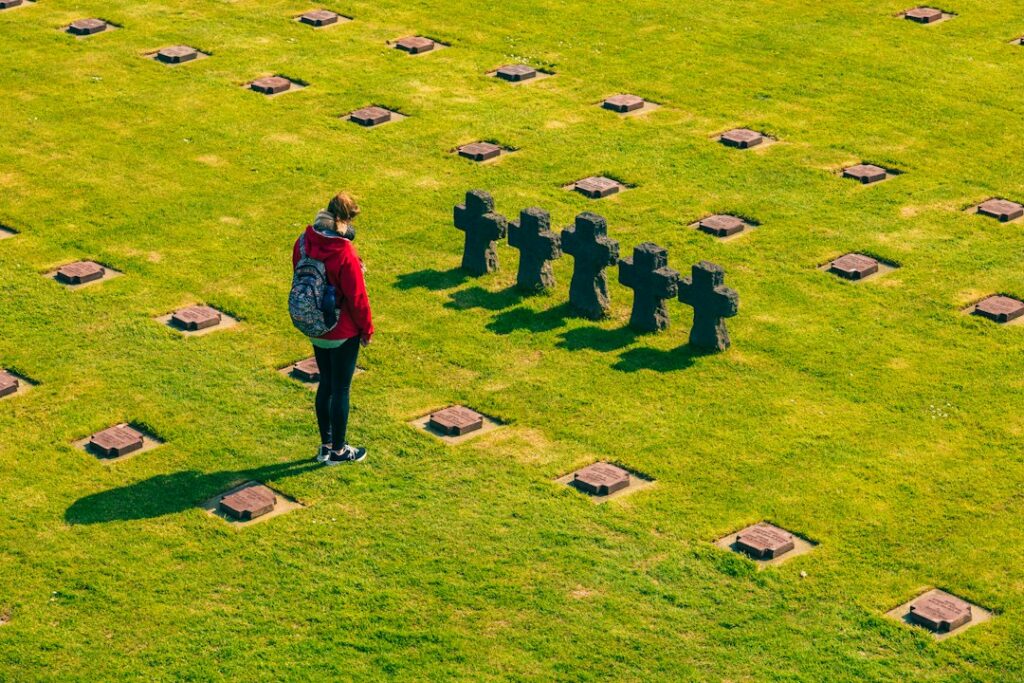
The central feature is a tumulus—an earth mound topped by a large basalt cross and flanked by sculptures of mourning parents. This mound alone contains the remains of 207 unknown soldiers and 89 identified ones. Throughout the rest of the cemetery, flat stone markers lie among the grass, each typically representing two soldiers, with some graves holding as many as six or seven.
Who Is Buried at La Cambe
The soldiers buried here range from teenagers conscripted in the final desperate months of the Third Reich to career officers. The youngest was just 16 years old. Many were members of the 12th SS Panzer Division Hitlerjugend, composed largely of fanatical Hitler Youth volunteers who fought with particular ferocity during the Normandy campaign.
The cemetery includes soldiers killed across the entire Normandy region, from the initial D-Day landings on June 6, 1944, through the breakout from the hedgerow country in late July and August. Their remains were gathered from temporary burial sites, battlefield graves, and even farms where they had been hastily interred.
A Place for Reflection, Not Celebration
The German government and the Volksbund have been careful to frame La Cambe as a site of reconciliation and peace education rather than military honor. Information panels throughout the cemetery acknowledge the criminal nature of the Nazi regime and the context of the war. School groups from Germany regularly visit as part of educational programs about the consequences of totalitarianism and aggressive war.
This approach stands in stark contrast to how military cemeteries were traditionally conceived. La Cambe asks visitors to confront uncomfortable questions: how do we memorialize those who fought for an evil cause? What responsibility do individual soldiers bear? How do we honor the dead without glorifying the war?
Visiting Today
La Cambe is located near the village of the same name, roughly halfway between Bayeux and Carentan in the Calvados department. The cemetery is open year-round without charge, maintained by the Volksbund through donations and membership fees from German citizens who support the organization’s mission of tending war graves and promoting peace education.
For visitors exploring the D-Day sites, La Cambe offers essential perspective. The Normandy invasion was not a bloodless liberation but a brutal battle in which young men on all sides died in terrible numbers. Walking among these 21,000 graves—many holding teenagers who never had the chance to question the ideology they’d been taught—provides a sobering counterpoint to triumphalist narratives of the war.
Tours & experiences in Germany


Powered by Viator. Some links are affiliate links — we may earn a small commission at no extra cost to you.