
Bamberg sits on seven hills in Upper Franconia, an hour north of Nuremberg, and remains one of Germany’s best-preserved medieval cities. The Allied bombers missed it during the war, and UNESCO recognized its 1,000-year streetscape in 1993. Today, the Altstadt feels like a living museum—not because it’s been reconstructed, but because it never needed to be.
The Regnitz River splits the old town into three historic quarters: the ecclesiastical Bergstadt on the hilltops, the commercial island district in the middle, and the gardening quarter on the eastern bank. Walking between them, you move through centuries of architecture, from Romanesque to Baroque, with half-timbered burgher houses leaning over narrow lanes.
The Altes Rathaus and the Island District
Start where everyone does: the Altes Rathaus, Bamberg’s old town hall, built on an artificial island in the middle of the Regnitz. Legend says the bishop refused to grant land for a town hall, so the citizens drove piles into the riverbed and built it there instead. The structure straddles the water, its frescoed facade overlooking the Obere Brücke.
Cross to the island district, known as the Inselstadt, where fishermen and millers once lived. The Klein Venedig (Little Venice) stretch along the eastern bank features a row of colorful half-timbered houses with tiny gardens backing onto the water. It’s postcard-perfect from the Untere Brücke, especially in late afternoon light.
The Geyerswörthstraße leads through the commercial heart, where the Grüner Markt hosts a daily market (Monday through Saturday) selling Franconian produce, flowers, and the famous Bamberger Hörnla potatoes. This is also where you’ll find Fässla, one of the city’s historic rauchbier breweries, if you want an early taste.
The Cathedral and Bergstadt
Climb the Domberg, the cathedral hill, to reach Bamberg’s ecclesiastical quarter. The Kaiserdom, dedicated in 1012 and rebuilt in the 13th century, anchors the hilltop. Inside, you’ll find the only papal tomb north of the Alps (Pope Clement II) and the Bamberg Rider, a 13th-century equestrian sculpture that’s become the symbol of the city—though no one knows who it depicts.
The Alte Hofhaltung, the former bishop’s residence, surrounds a cobbled courtyard lined with half-timbered galleries. Next door, the Neue Residenz offers lavish Baroque state rooms and a rose garden terrace with sweeping views over the red rooftops and the Michaelsberg monastery on the opposite hill.
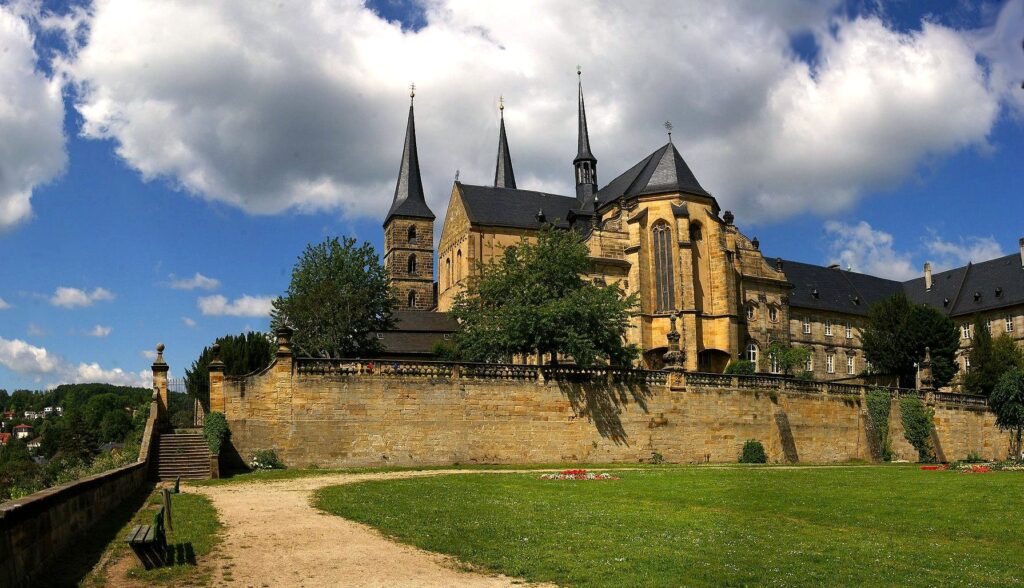
Walk west to Michaelsberg, where the Benedictine abbey church crowns another hilltop. The painted ceiling inside depicts more than 500 species of plants—Franconia’s botanical encyclopedia rendered in Baroque splendor. The terraced gardens below offer another vantage point over the city.
Rauchbier: Bamberg’s Liquid Smoke
Bamberg is the world capital of rauchbier, or smoked beer, brewed with malt dried over beechwood fires. The result tastes like a campfire in a glass—polarizing for first-timers, addictive for converts. Two breweries keep the tradition alive in the city center.
Schlenkerla, officially Brauerei Heller, pours its Märzen rauchbier in a centuries-old tavern on Dominikanerstraße. The dark, smoky lager pairs surprisingly well with Franconian pork dishes. Arrive early for a table in the vaulted cellar, or stand elbow-to-elbow at the bar upstairs.
Spezial, on Obere Königstraße, offers a lighter rauchbier and a quieter atmosphere. The brewery has been family-owned since 1536, and the attached Wirtshaus serves hearty Schäufele (roasted pork shoulder) and onion-crusted Bamberger Zwiebel, a local specialty.
If smoked beer isn’t your style, Bamberg has nine breweries total, including Fässla (unsmoked lagers) and Greifenklau (a tiny brewpub tucked near the cathedral). The Franconian beer culture here runs deep—this is a walking city built on malt and hops.
Practical Tips for Visiting Bamberg
Bamberg is an easy day trip from Nuremberg (45 minutes by regional train) or a worthy overnight stop if you’re exploring Franconia. The Altstadt is compact and walkable—you can cover the main sights in half a day, but the city rewards a slower pace.
The Touristinformation Bamberg, inside the Geyerswörthstraße building near the Altes Rathaus, offers maps and brewery route suggestions. If you’re visiting in August, the Sandkerwa festival transforms the island district into a five-day street party with beer tents, live music, and traditional dragon boat races on the Regnitz.
For a quieter experience, visit on a weekday morning. The cathedral and hilltop quarters are nearly empty before 10 a.m., and the market on Grüner Markt is in full swing by 8. Pack comfortable shoes—the cobbled hills are steep, and the best views require a climb.
Bamberg isn’t on the Rhine or the Romantic Road, and that’s exactly its charm. This is a city that’s been brewing beer and building cathedrals for a thousand years, and it’s still doing both exceptionally well.
Want stories like this in your inbox? Subscribe to the Love Germany newsletter—one short story a day, exploring the Germany beyond the guidebooks.
Tours & experiences in Germany


Powered by Viator. Some links are affiliate links — we may earn a small commission at no extra cost to you.