
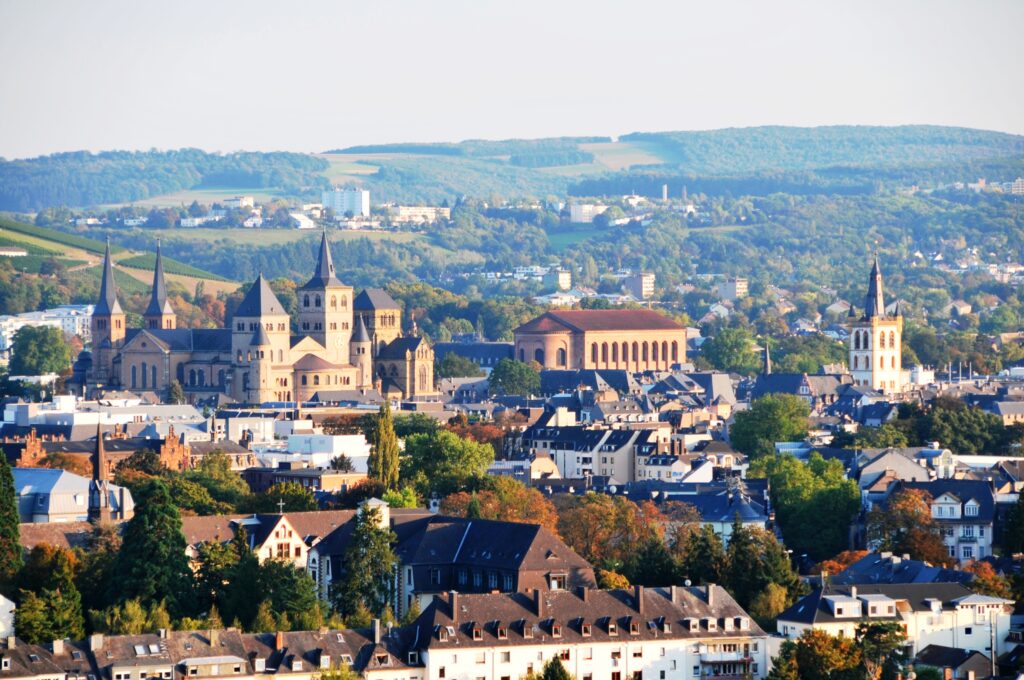
Trier doesn’t just claim to be Germany’s oldest city—it proves it. Founded as Augusta Treverorum in 16 BC, this Moselle River town served as the capital of the Western Roman Empire for nearly two centuries. Today, nine UNESCO World Heritage sites dot its compact center, and you can walk from the massive Porta Nigra gate to Constantine’s throne room in fifteen minutes.
Most German cities lost their Roman heritage to medieval rebuilding or wartime bombing. Trier kept its monuments intact, and the result is a living textbook of imperial architecture surrounded by Moselle vineyards and half-timbered wine taverns.
The Porta Nigra and the Roman Quarter
The Porta Nigra—the “Black Gate”—is the largest Roman city gate north of the Alps, and it dominates Trier’s northern entrance. Built around 170 AD from massive sandstone blocks held together without mortar, the gate survived because a Byzantine monk turned it into a church in the 11th century. Napoleon ordered the medieval additions removed, revealing the original Roman structure.
You can climb through the gate’s interior passages for views over the Altstadt. The stone has darkened over centuries of weathering, giving the monument its name. It’s open daily, and a combined ticket covers entry to most of Trier’s Roman sites.
Walk south from the Porta Nigra down Simeonstraße to reach the Hauptmarkt, Trier’s market square since the Middle Ages. The Petrusbrunnen fountain sits at its center, and cafés line the square under baroque façades. From here, it’s a short walk east to the Imperial Baths (Kaiserthermen), where you can descend into the underground service corridors that once heated the massive bathing complex.
The Basilica and Cathedral
Constantine’s Basilica—officially the Aula Palatina—is the largest surviving single-room structure from antiquity. Built in 310 AD as the emperor’s throne hall, the brick building now serves as Trier’s Protestant church. The interior is startlingly plain: a vast rectangular space with no columns, just walls rising to a coffered ceiling 33 meters high. It’s free to enter when services aren’t in session.
Next door, Trier’s Cathedral (Dom St. Peter) incorporates walls from Constantine’s original palace chapel, making parts of it 1,700 years old. The building grew through the centuries—Romanesque nave, Gothic choir, baroque towers—but Roman bricks are visible in the core. The cathedral houses the Holy Robe, a tunic tradition holds was worn by Christ, displayed publicly only once or twice per decade.
Don’t miss the Liebfrauenkirche next to the cathedral, one of Germany’s earliest Gothic churches and connected to the Dom by a cloister.
The Amphitheater and Moselle Views
Trier’s Roman amphitheater sits on a hillside southeast of the center, a 20-minute walk from the Porta Nigra. Built around 100 AD to seat 20,000 spectators, it’s smaller than the Colosseum but better preserved than most German ruins. You can walk through the underground chambers where gladiators and animals waited before being lifted into the arena.
The amphitheater’s location on the Petrisberg offers views over the Moselle Valley. In summer, the arena hosts concerts and open-air theater—a modern echo of its original purpose.
For more sweeping views, follow the trail uphill to the Weishaus viewpoint, or cross the river to the wine village of Pfalzel, where vineyard paths climb above the valley.
Wine, Practical Tips, and Where to Eat
Trier sits in the heart of Moselle wine country, and the local Riesling is crisp and mineral-driven. The best place to try it is in one of the city’s traditional wine taverns—Weinstube Kesselstatt on Liebfrauenstraße occupies a Gothic cellar and pours estate wines from the surrounding slopes. Zum Domstein, near the cathedral, serves regional dishes like Moselle pike-perch and Dibbelabbes, a Saarland potato cassertic.
Trier is compact enough to explore on foot. Most Roman sites open daily from 9 or 10 a.m., closing earlier in winter. The Trier Card offers free public transport and discounts on museums. The city is an easy day trip from Luxembourg (30 minutes by train), Koblenz (90 minutes), or Saarbrücken (one hour), but staying overnight lets you explore the Moselle wine villages upstream toward Bernkastel.
The Rheinisches Landesmuseum, just south of the Imperial Baths, holds the finest collection of Roman artifacts in Germany, including the famous Neumagener Weinschiff, a stone relief of a Roman wine boat from the Moselle.
When to Visit
Trier shines from May through October, when outdoor cafés fill the Hauptmarkt and vineyard trails are at their best. September brings the grape harvest and wine festivals in surrounding villages. The Christmas market, held around the Porta Nigra and Hauptmarkt, is smaller than the famous Rhineland markets but atmospheric against the Roman backdrop.
Winter is quiet—ideal if you want the ruins to yourself—but some sites reduce their hours between November and March.
Trier rewards slow exploration. This is a city where you can tour a Roman bathhouse in the morning, drink wine in a medieval cellar at lunch, and watch the sun set over the Moselle from a hillside amphitheater. The layers of history sit comfortably together, and the city wears its age lightly.
Want more stories about Germany’s hidden corners and essential destinations? Subscribe to the Love Germany newsletter—one short story a day, straight to your inbox.
Tours & experiences in Germany


Powered by Viator. Some links are affiliate links — we may earn a small commission at no extra cost to you.