Franconia doesn’t do tourism spectacles. Instead, this northern Bavarian region—stretching from Bamberg through Nuremberg to the Franconian Switzerland—celebrates itself quietly, with village festivals that have remained essentially unchanged for centuries. Miss the tour buses, find the soul.
These aren’t events staged for visitors. They’re the genuine article: local celebrations where you’re simply welcome to join in. And that difference is everything.
Kirchweih: Franconia’s Village Feast Days
Every Franconian village celebrates its Kirchweih—literally “church consecration”—on the anniversary of its parish church dedication. Unlike the organized chaos of Munich’s Oktoberfest, these are hyper-local affairs that last three to four days, typically running from late August through October.
In Forchheim, the Annafest transforms the Kellerwald—a hillside forest dotted with 24 beer cellars—into an open-air drinking village each late July. Over a million visitors come for the five beer gardens serving beer straight from the rock cellars where it’s been lagering since spring. No brewery tents, no amplified music—just long wooden tables under chestnut trees and ceramic mugs of Kellerbier.
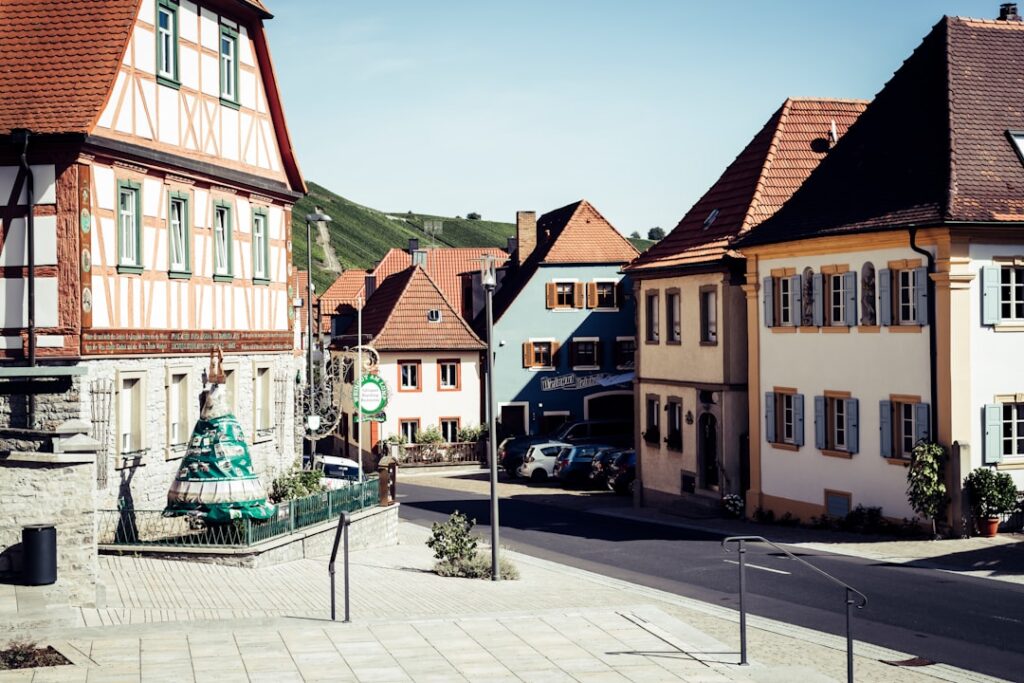
Smaller Kirchweih celebrations happen throughout the region. In Effeltrich, northeast of Forchheim, the September Kirchweih still features the traditional Kirchweihbaum—a decorated pole carried through the village by young men. In Großgeschaidt, locals maintain the custom of serving fresh-slaughtered geese at their October festival.
The pattern repeats in dozens of villages: beer from local breweries, roast pork or duck, potato dumplings, and dancing to brass bands. Each village claims its Kirchweih is the “real” one. They’re all right.
Wine Festival Season in Franconian Wine Country
Franconia’s wine country along the Main River celebrates harvest season with festivals that put the focus squarely on Silvaner, Müller-Thurgau, and the region’s other distinctive wines served in the traditional Bocksbeutel—the squat, flat-sided bottle you won’t find anywhere else in Germany.
Würzburg’s Weindorf, held for ten days each late May and early June on the Marktplatz, gathers wine growers from throughout Franconia. Each operates a small wooden hut serving their wines alongside local specialties. It’s a civilized affair—no carnival rides, just wine, conversation, and the baroque splendor of the Marktplatz after dark.
In Iphofen, the Weinfest each August fills the medieval town center with wine stands and transforms the Kirchplatz into an outdoor tasting room. The town’s three wine cooperatives and numerous private vintners pour generously. Come hungry: the Winzerschnitzel—a pork cutlet in wine sauce—pairs perfectly with a cool Silvaner.
Volkach’s Weinfest in mid-August adds a river setting to the equation. The little Main River town’s celebration spreads along the waterfront promenade, with wine stands facing the river and live music echoing off the Renaissance buildings. Book a room early; Volkach has maybe a dozen small hotels, and they fill quickly.
When Cherries Rule: Forchheim’s Kaiserpfalz Fest
Every June, Forchheim shifts gears from beer to its other local obsession: cherries. The Franconian Switzerland produces some of Germany’s finest sweet cherries, and the three-day Kaiserpfalz Fest celebrates with cherry wine, cherry beer, cherry schnapps, and roughly a dozen variations on cherry cake.
The festival fills the courtyard of Forchheim’s medieval Kaiserpfalz with market stalls and beer gardens, but the cherry theme keeps it distinct. Local distillers pour Kirsch—cherry brandy—that would cost €8 a shot in a Munich bar but flows freely here for half that. The Kirschmichel—a cherry bread pudding—appears on every menu, served warm with vanilla sauce.
Planning Your Festival Visit
Franconian village festivals don’t advertise heavily outside the region. Check local tourism websites for exact dates, which shift slightly year to year based on church calendars and harvest timing. The Franconian tourist board maintains a decent festival calendar, though it’s more complete in German than English.
Book accommodation well ahead for the larger festivals like Forchheim’s Annafest or Würzburg’s Weindorf. For smaller village Kirchweih celebrations, staying in a nearby larger town works fine—most villages are within a 20-minute drive of Bamberg, Nuremberg, or Würzburg.
Trains connect the major towns, but many of the best village festivals require a car or local bus. Sunday bus service can be sparse, so plan accordingly.
These festivals start early—often by 10 a.m. on weekends—and wind down by 11 p.m. or midnight. They’re family affairs, with children running between tables and grandparents holding court. Dress codes don’t exist, though you’ll see plenty of Tracht—traditional Franconian dress—especially at Kirchweih celebrations.
Most importantly: don’t arrive expecting English menus or English-speaking staff. These are local festivals that happen to welcome outsiders, not tourist events. A few words of German and a willingness to point at what your neighbor is eating will serve you well.
Want more stories from Germany’s regions, festivals, and hidden corners? Subscribe to the Love Germany newsletter—one short story about Germany, delivered to your inbox each day.
Tours & experiences in Germany


Powered by Viator. Some links are affiliate links — we may earn a small commission at no extra cost to you.