
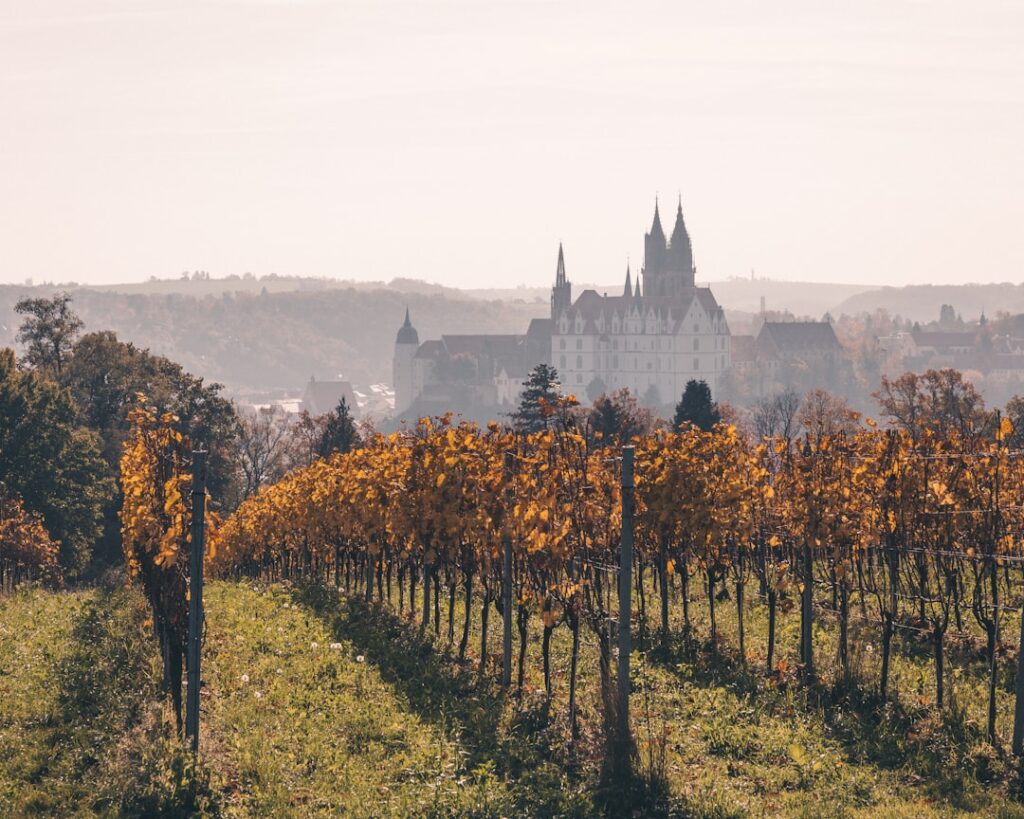
Meissen doesn’t shout for attention the way Dresden does, but this compact Saxon town along the Elbe River delivers one of eastern Germany’s most rewarding day trips. It’s where Europe’s first porcelain was born in 1710, where some of Germany’s northernmost wine grows on impossibly steep slopes, and where a Gothic cathedral and Albrechtsburg castle share a hilltop that’s anchored the skyline for a millennium.
The journey from Dresden takes just 30 minutes by S-Bahn, making Meissen an easy escape that feels worlds away from the capital’s crowds.
The Porcelain Manufactory: Where It All Began
The State Porcelain Manufactory Meissen—known for its crossed blue swords trademark—sits on the opposite bank from the old town. This is where Johann Friedrich Böttger cracked the secret of hard-paste porcelain in 1708, ending China’s centuries-long monopoly. The guided tour through the Erlebniswelt Haus Meissen lets you watch artisans hand-paint the delicate patterns that have made Meissen porcelain coveted worldwide.
You’ll see turners shaping white gold on wheels, painters applying the famous onion pattern with steady hands, and the massive kilns where pieces are fired at over 1,400 degrees Celsius. The museum displays historical pieces including Augustus the Strong’s original commissions—fantastical animals and elaborate table settings that were once worth their weight in actual gold.
Book the demonstration workshop if you want to try painting your own piece. The manufactory shop is predictably expensive, but the seconds outlet next door offers slightly imperfect pieces at more reasonable prices.
Albrechtsburg and the Cathedral
Cross back to the old town and climb the narrow lanes to the Burgberg, where Albrechtsburg castle and Meissen Cathedral share a dramatic perch above the river. Albrechtsburg, completed in 1524, is considered Germany’s oldest castle built as a residence rather than a fortress. Its late Gothic halls twist through spiraling staircases and vaulted chambers—for two centuries, it housed the porcelain manufactory before that operation moved to larger quarters.
The cathedral next door took 600 years to complete, and its mismatched towers tell that story. The interior’s stained glass and carved altarpieces are exceptional, and the view from the tower platform stretches across the Elbe valley and the red rooftops below.
The combined ticket for both buildings is worth it, and you’ll want at least two hours to do them justice.
Wine Slopes and the Historic Market Square
Meissen sits in Saxony’s tiny wine region, and the slopes above town produce some of Germany’s northernmost Riesling, Müller-Thurgau, and Weißburgunder. The vineyard terraces are among the steepest in Germany—some approach 60 percent grade—and have been cultivated since 1161.
Several family-run wine estates offer tastings. Weingut Schloss Proschwitz, just outside town, is the region’s largest organic producer and serves lunch in its courtyard restaurant with views over the vines. Closer to the center, Weingut Vincenz Richter operates a historic wine tavern in a half-timbered house on Andreasstraße that’s been pouring wine since 1523.
The Marktplatz in Meissen’s Altstadt is ringed with Renaissance townhouses painted in soft yellows and greens. The late Gothic Rathaus anchors one corner, while cafés spill onto the square. Stop at Café Zieger for Eierschecke, Saxony’s three-layer custard cake that’s richer and more complex than it has any right to be.
Getting There and Planning Your Visit
S-Bahn line S1 runs every 30 minutes from Dresden Hauptbahnhof to Meissen-Triebischtal station, taking about 30 minutes. From there, it’s a 15-minute walk across the Elbe bridge to the old town, or you can catch bus line A to the Marktplatz.
If you’re driving, parking is available near the porcelain manufactory and at several lots below the old town—the steep cobbled streets aren’t car-friendly.
Start early to avoid tour groups at the manufactory, which tend to arrive mid-morning. Meissen is manageable as a half-day trip, but a full day lets you linger over lunch, explore the wine terraces, and take your time in the cathedral without rushing back to Dresden.
The town is open year-round, though the vineyard walks are most rewarding from May through October when the vines are in leaf. December brings a small, atmospheric Christmas market to the Marktplatz that feels refreshingly local compared to Dresden’s massive Striezelmarkt.
Want more German towns, day trips, and travel stories delivered to your inbox? Subscribe to the Love Germany newsletter—one short story a day exploring the Germany beyond the guidebooks.
Tours & experiences in Germany


Powered by Viator. Some links are affiliate links — we may earn a small commission at no extra cost to you.