
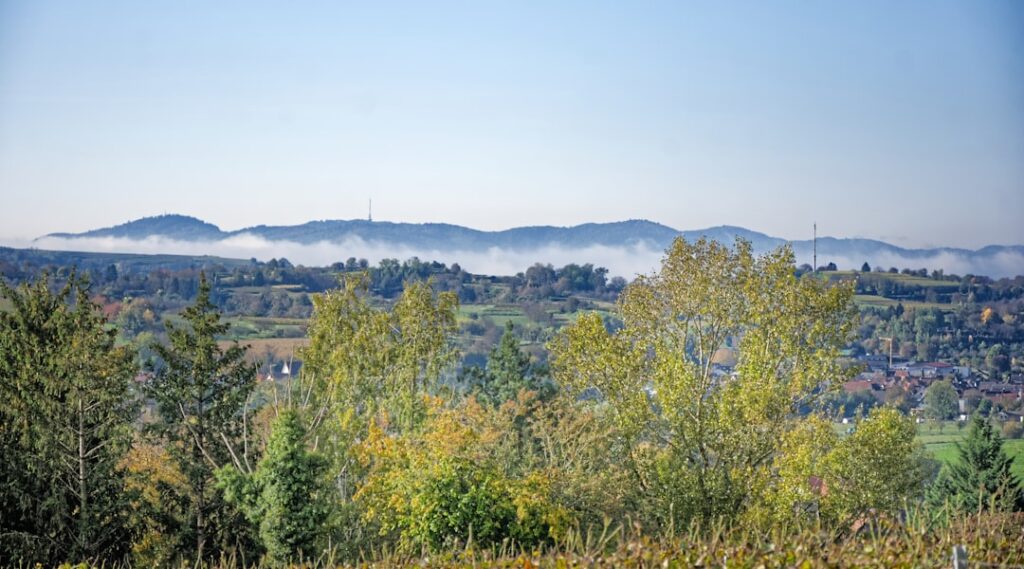
Tucked against the western slopes of the Black Forest, Freiburg im Breisgau basks in more sunshine than almost anywhere else in Germany. This university city of 230,000 combines a beautifully preserved medieval Altstadt with a forward-thinking environmental culture, vineyard-covered hillsides, and mountain trails that begin at the city’s edge. It’s the ideal base for exploring the southern Black Forest while enjoying urban amenities and some of the country’s best weather.
The Münster and the Medieval Heart
Freiburg’s red sandstone cathedral, the Münsterplatz, dominates the old town with its filigree Gothic spire—one of the few completed in the Middle Ages. Climb the tower’s 329 steps for sweeping views across the terracotta rooftops to the Vosges mountains in France. The interior holds stunning stained glass windows, some dating to the 13th century, and Hans Baldung Grien’s Renaissance altarpiece.
The square surrounding the cathedral hosts one of Germany’s best daily markets. From Monday through Saturday, farmers from the surrounding valleys sell everything from wild mushrooms to Lange Rote sausages, a local specialty. The wooden market stalls have occupied this spot for more than 900 years. Try a slice of fresh Flammkuchen from one of the stands—Freiburg’s proximity to Alsace means this thin-crust, bacon-and-onion tart is done exceptionally well here.
Throughout the Altstadt, small streams called bächle run along the cobbled streets in channels that date to the medieval water system. Local legend says if you accidentally step in one, you’ll marry a Freiburger. The canals once supplied water for fighting fires and watering livestock; today they’re a charming quirk that keeps the city center noticeably cooler in summer.
The Schlossberg and Vineyard Trails
The forested Schlossberg hill rises immediately east of the old town, offering hiking trails, a lookout tower, and a beer garden with panoramic views. You can walk up in about 20 minutes via stone staircases, or take the Schlossbergbahn, a funicular railway that’s been carrying visitors uphill since 1888. At the summit, the reconstructed castle tower provides 360-degree views from the Rhine plain to the Black Forest peaks.
South of the city center, the Tuniberg and Kaiserstuhl wine regions produce exceptional Baden wines—Burgundy varietals thrive in the volcanic soil and warm microclimate. The village of Ihringen, just 20 minutes by regional train, holds Germany’s heat record and grows spectacular Spätburgunder (Pinot Noir). Walk the vineyard trails between Ihringen and Achkarren, stopping at family-run wine estates for tastings. The gentle hills offer some of the most accessible wine hiking in Germany, with clearly marked routes and numerous Straußwirtschaften—seasonal wine taverns where winemakers serve their own bottles with simple platters of cheese, ham, and bread.
Gates, Canals, and Green Living
Two medieval city gates still stand: the Martinstor, with its colorful frescoes and McDonald’s improbably tucked into the 13th-century stonework, and the Schwabentor, adorned with a painted mural of St. George slaying the dragon. The pedestrian zone connecting them—Kaiser-Joseph-Straße—forms the main shopping artery, lined with department stores, cafés, and the baroque Altes Rathaus.
Freiburg earned its reputation as Germany’s environmental capital through decades of green urban planning. The Vauban neighborhood, a former military barracks turned eco-district, showcases car-free streets, solar panels on nearly every roof, and a community-designed layout that’s become a model for sustainable development worldwide. Trams run through the district every few minutes; most residents rely on bicycles. It’s worth a short tram ride to see urban planning done right.
The city’s innovative spirit extends to its transit system—Freiburg’s tram network is one of Germany’s most efficient, and the Regio-Karte pass offers unlimited travel throughout the surrounding Black Forest region. The main train station connects to Basel in 45 minutes and Baden-Baden in an hour, making day trips effortless.
When to Visit and Where to Stay
Freiburg shines brightest from late April through October, when the weather favors outdoor markets, vineyard walks, and mountain hikes. July and August bring university students home for summer, leaving the city pleasantly uncrowded. December’s Christmas market fills Rathausplatz and the cathedral square with wooden chalets selling handcrafted ornaments and mulled wine.
Stay within the old town to walk everywhere—hotels cluster around Bertoldsbrunnen and the quieter streets south of the Münster. The neighborhood of Wiehre, just across the Dreisam River, offers good-value guesthouses within a 10-minute walk of the center. From anywhere in Freiburg, you’re never more than a tram ride from a trailhead.
Freiburg rewards slow exploration: morning coffee at the Münster market, an afternoon hike up the Schlossberg, evening wine in a Kaiserstuhl village. It’s a city that lives well, and visitors feel it immediately.
Want more Germany stories like this delivered to your inbox? Subscribe to the Love Germany newsletter—one short story about Germany every day, from hidden villages to local traditions.
Tours & experiences in Germany


Powered by Viator. Some links are affiliate links — we may earn a small commission at no extra cost to you.