
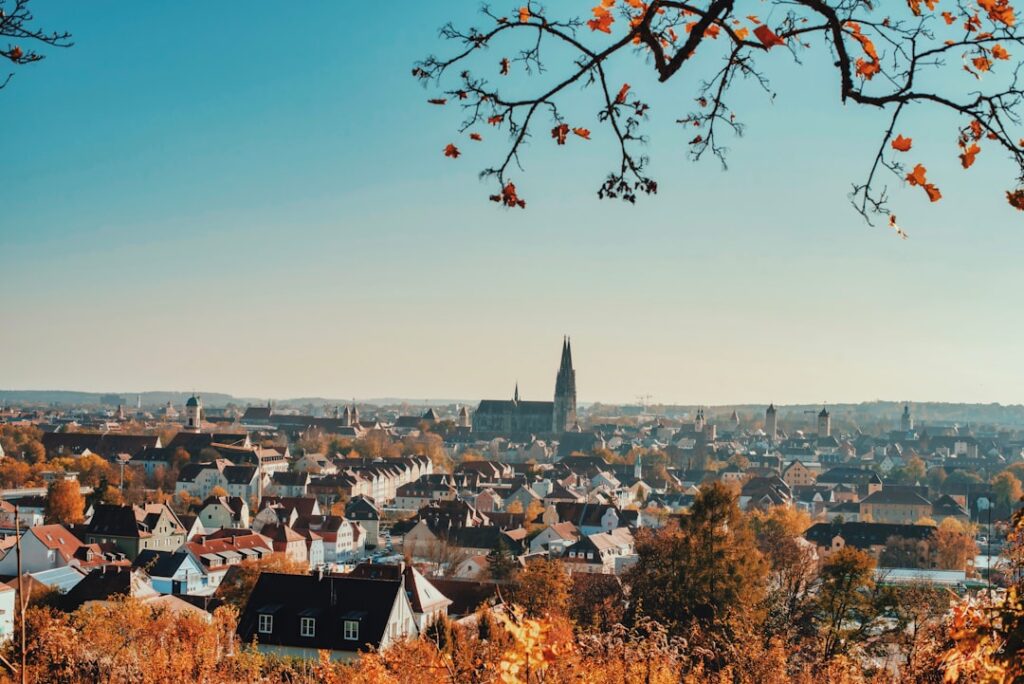
While Munich and Nuremberg draw the crowds, Regensburg remains Bavaria’s best-kept secret—a city where medieval lanes, Romanesque churches, and Gothic spires crowd together on a bend in the Danube. With more than 1,500 protected buildings packed into its Old Town, this UNESCO World Heritage site gives you a clearer picture of what a prosperous medieval city looked like than almost anywhere else in Germany.
Founded by the Romans as Castra Regina in 179 AD, Regensburg grew wealthy as a Free Imperial City and trading hub. Unlike most German cities, it escaped heavy bombing during World War II, leaving its medieval core remarkably intact. Today, you can walk streets that have looked essentially the same for 800 years.
The Stone Bridge and the Wurstkuchl
Start at the Steinerne Brücke, the 12th-century stone bridge that spans the Danube in sixteen graceful arches. For 800 years, this was the only stone bridge crossing the river between Ulm and Vienna, making Regensburg essential to trade routes connecting Venice, Prague, and Paris. The bridge itself is a masterpiece of medieval engineering—walk across for views of the pastel-colored patrician houses lining the riverbank.
Just steps from the bridge’s southern end sits the Wurstkuchl, Germany’s oldest continuously operating sausage kitchen. Since 1146, this tiny timber structure has been grilling Regensburger sausages over beechwood fires and serving them with sauerkraut and fresh mustard. The recipe hasn’t changed: six small sausages, charred on the outside, juicy within, served on a tin plate. Grab a spot at the outdoor benches and eat like the medieval stonemasons who built the bridge—they were the kitchen’s first customers.
The Dom and the Old Town Labyrinth
Regensburg’s Cathedral of St. Peter dominates the skyline with twin spires that rise 105 meters above the city. This Gothic masterpiece, begun in 1275 and completed in the 19th century, houses stunning medieval stained glass windows—some of the finest in Germany. The original glass from the 14th century fills the choir with jewel-toned light that shifts throughout the day.
Behind the cathedral, lose yourself in the warren of narrow lanes that make up the Old Town. Look up as you wander: Regensburg has more medieval tower houses than any other city north of the Alps. Wealthy merchant families built these stone towers—some reaching nine stories—as symbols of prestige and power in the 13th and 14th centuries. The Goldener Turm on Wahlenstrasse stands nine stories tall and still leans slightly, testament to the ambitious engineering of its builders.
The Altes Rathaus (Old Town Hall) on Rathausplatz served as the seat of the Perpetual Imperial Diet from 1663 to 1806, making it the first permanent parliament in German-speaking lands. You can tour the Imperial Hall and the original torture chamber in the basement—a sobering reminder of medieval justice.
Eating and Drinking Like a Local
Beyond the famous Wurstkuchl, Regensburg offers serious eating. The city’s student population (home to a large university) keeps prices reasonable and the dining scene lively. Head to Historische Wurstkuchl for those legendary sausages, but also explore Kneitinger or Bischofshof, both traditional brewpubs serving hearty Bavarian fare alongside their own beers.
For something lighter, Café Prinzess on Rathausplatz bakes exceptional cakes and serves excellent coffee in a building dating to 1600. The apple strudel, served warm with vanilla sauce, is worth the stop.
Regensburg also surprises with its own wine culture—the city sits at the northernmost edge of Bavaria’s wine-growing regions. Small wine bars in the Old Town pour local Silvaner and Riesling alongside the expected beer.
When to Visit and How to Get There
Regensburg works as a day trip from Munich (90 minutes by direct regional train) or Nuremberg (one hour), but the city rewards an overnight stay. Book a hotel in the Old Town itself—many occupy historic buildings with medieval cellars and beamed ceilings.
Visit in late spring or early autumn for the best weather and fewer crowds. The Christmas market, held in several squares throughout the Old Town, transforms the medieval streets into something from a fairy tale, though accommodations book up months ahead.
Summer brings the Bürgerfest in July, when the entire Old Town becomes one massive street festival with live music, local food, and beer gardens set up in historic courtyards. The Dult, a traditional fair held three times yearly on the Dultplatz, offers carnival rides, beer tents, and the kind of atmosphere that’s been drawing crowds for centuries.
The compact Old Town is entirely walkable—you won’t need a car, and most of the center is pedestrianized anyway. Comfortable shoes are essential; those medieval cobblestones are authentic and unforgiving.
Regensburg gives you medieval Germany without the tour buses, authentic Bavarian life without the lederhosen kitsch, and 2,000 years of history packed into streets you can explore in a long weekend. It’s the Germany that exists when you step off the main tourist trail.
Want more stories about Germany’s hidden gems and insider travel tips? Subscribe to the Love Germany newsletter and get one short story about Germany delivered to your inbox every day.
Tours & experiences in Germany


Powered by Viator. Some links are affiliate links — we may earn a small commission at no extra cost to you.